




Home \(\blacktriangleright\) Children and Youth Unit \(\blacktriangleright\) Arrows Website \(\blacktriangleright\) Museums in France \(\blacktriangleright\) Activity 1: Between Home and Museum
Activity 1: Between Home and Museum
The following activity (by Hadas Netzer Dagan) addresses an important layer in preparing children for a museum visit: creating a connection between their familiar environment and the museum environment, so they feel ‘at home’ in it.
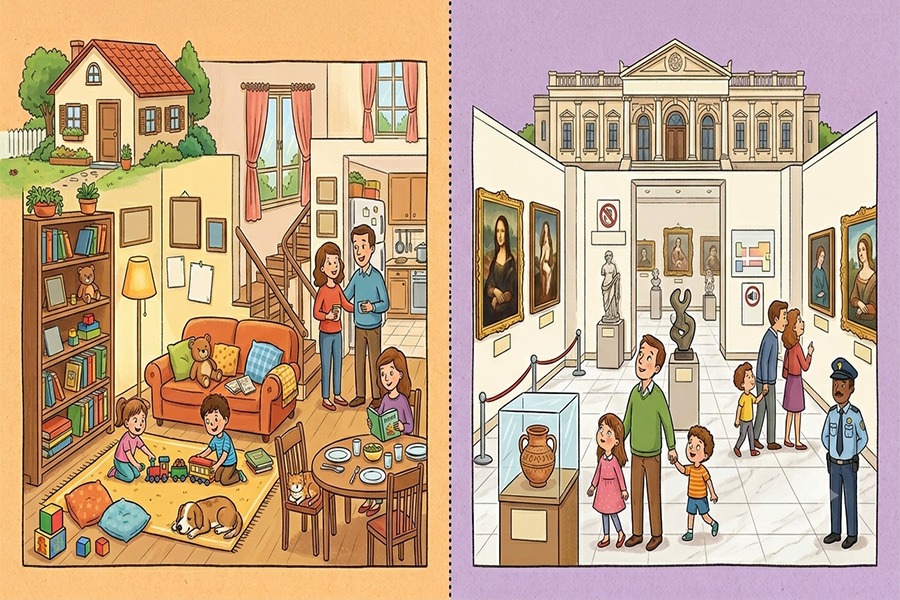
To do this, we will embark on a journey that begins with observing the home environment and the way we display objects at home.
Afterwards, we will imagine together the experience of visiting abroad, and especially France, compared to the home, and in Israel, through a virtual tour of their websites.
We will compare an ordinary household object to a well-known French artwork and understand the change in value and meaning.
The journey will reach its peak in a physical visit to the Hecht Museum at the University of Haifa (detailed in a separate activity).
It is important that during the actual visit, you reference the preparation that was done and connect the experience of the visit to what you imagined in advance.
You can talk with the children about similarities and differences between the home and the museum, as well as the dimensions of the museum space, the exhibits, and their feelings in front of them. For example, we will compare the size and design of a room in a private home to a magnificent gallery in a French museum.

The Activity
Observing the Living Room at Home
Start the activity in the living room at home.
Ask the children to look around them as if it were the first time they are seeing their living room.
Examine together with them what objects are used for display in the home (pictures, decorative accessories, furniture, electrical appliances).
Which of them are particularly prominent (and what actually makes them stand out), which look of significant value, and why?
Think together, what story do the objects displayed in the house tell about the family living in it.
The way different spaces are designed conveys a message regarding the importance and meaning granted to them and to staying in them. Thus, for example, high ceilings and the design of large and high spaces are used to impart a sense of sacredness in houses of worship of different religions (synagogues, churches, and mosques).
In the same way, the design of the home living space conveys a message regarding the importance of objects in it and the nature of the stay in it. Thus, for example, the fact that most furniture in the living room faces the television and each other in most homes hints at the accepted nature of the stay in the living room and the quality of the interactions that take place while staying in it (for example: joint television watching, family conversation, and more).
Imagining the Museum
We will now turn to look at the website of a museum abroad (such as the Louvre or the Musée d’Orsay in France) and at the website of an Israeli museum (such as the Hecht Museum in Haifa).
Look at the pictures of the exhibition spaces, and address the following issues:
- Comparison Between Home and Museum: Does the design of the spaces in the museum remind you of your living room? How are they different? How are they similar?
\(\space\) - Feeling at First Glance: What kind of feeling do the high and large spaces evoke in you?
\(\space\) - The Story of the Objects: What do you think the objects displayed in the museum tell? What story can they tell about the period or culture they come from?