




Home \(\blacktriangleright\) Research \(\blacktriangleright\) Research Laboratories \(\blacktriangleright\) Neurocognitive Creativity & Giftedness Laboratory
Neurocognitive Creativity & Giftedness Laboratory
Prof. Roza Leikin
Head of the Laboratory
Dr. Ilana Waisman
Laboratory Manager
Prof. Mark Leikin
Former Head of the Laboratory (2008–2024)
About the Lab
The Neurocognitive Laboratory at Range Center, operating under the Faculty of Education at the University of Haifa, serves as a unique research intersection combining neuroscience with the study of human potential.
The laboratory, currently led by Prof. Roza Leikin and Dr. Ilana Waisman (following the leadership of Prof. Mark Leikin, who headed it from 2008–2024, alongside Dr. Waisman), focuses on decoding the biological and cognitive mechanisms underlying phenomena such as giftedness, creativity, and expertise in various disciplines, primarily mathematics.
Methodology
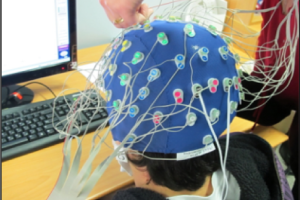
Unlike traditional educational laboratories, this facility utilizes advanced technologies for monitoring brain activity, such as EEG (Electroencephalogram) and ERP (Event-Related Potential), which allow researchers to observe, in real-time, the brain’s information processing methods while solving complex problems. In contrast to psychological studies that rely on questionnaires, the laboratory examines the “brain signature” of problem-solving, with a special emphasis on the fields of mathematics and language.
Main Research Areas
The center supports and encourages multidimensional and multidisciplinary research into the natural complexity existing in creativity, ability, and giftedness. Simultaneously, the center promotes research concerning ways to foster these qualities among diverse populations.
In this framework, the research conducted by center members focuses on:
Social and cognitive processes related to the realization of intellectual potential.
Learning processes and learning environments that lead to the development of abilities.
Basic and advanced cognitive skills related to creativity, giftedness, and expertise.
Neurocognitive activity among individuals with abilities at different levels.
Development of ways for diagnosing and identifying high abilities and exceptional creativity.
Ways to foster creativity among the general population.
The role of the family in realizing high abilities.
Research Focus
"Neural Efficiency"
One of the central research axes in the laboratory examines the concept of “Neural Efficiency” among populations with high abilities. The laboratory’s studies investigate whether the brains of gifted individuals operate more economically, or if the complexity of solving creative problems actually requires the recruitment of broader brain resources (Waisman, Brunner, Grabner, Leikin & Leikin, 2023).
Key Finding: Resource Recruitment
These findings show that in gifted individuals, the brain is not necessarily “easier” to use, but rather recruits unique cognitive resources during tasks that require creativity and unconventional thinking.
ERP Technology
The ERP technology used by the laboratory allows researchers to isolate the milliseconds in which a cognitive “spark” occurs and to see which brain areas are involved.
The laboratory’s work is particularly groundbreaking in the study of “Insight” – those “Eureka” moments in which a sudden creative solution is formed. Through the analysis of brain waves, the laboratory team maps the differences between students who demonstrate standard excellence and those gifted with exceptional creativity and cognitive flexibility (Waisman, Leikin & Leikin, 2025).
Multidimensional Approach and Impact
Beyond the laboratory-biological aspect, the laboratory examines the connection between brain processes and the realization of intellectual potential. The studies span a wide range of topics, from measuring cognitive load to developing innovative learning environments adapted to the learner’s neural characteristics.
This multidimensional approach allows the laboratory not only to contribute to theoretical academic knowledge but also to influence the development of innovative ways for diagnosing high ability and research-based teaching methods for gifted children (Leikin, 2021) and populations with special needs, such as children on the autism spectrum who exhibit exceptional skills.
Groundbreaking Research
For example, in one study, the laboratory researchers demonstrated how it is possible to identify exceptional mathematical creativity even in cases where verbal creativity is low, thereby contributing to the development of new diagnostic tools based on brain and cognitive functioning rather than just overt behavior (Hetzroni, Agada & Leikin, 2019).
The research activity at the laboratory receives broad international recognition, and it maintains close ties with leading research centers worldwide and global organizations for the study of giftedness, such as ECHA (European Council for High Ability) and WCGTC (World Council for Gifted and Talented Children). The laboratory’s academic publications in prestigious journals in the fields of neuropsychology and mathematics education position it as a leading center of excellence of its kind, which succeeds in bridging the gap between the research laboratory and the world of education and field practice.
📚 References
Hetzroni, O., Agada, H., & Leikin, M. (2019). Creativity in autism: an examination of general and mathematical creative thinking among children with autism spectrum disorder and children with typical development. Journal of autism and developmental disorders, 49(9), 3833-3844. https://doi.org/10.1007/s10803-019-04094-x
Leikin, R. (2021). When practice needs more research: the nature and nurture of mathematical giftedness. ZDM–Mathematics Education, 53(7), 1579-1589. https://doi.org/10.1007/s11858-021-01276-9
Waisman, I., Brunner, C., Grabner, R. H., Leikin, M., & Leikin, R. (2023). (Lack of) neural efficiency related to general giftedness and mathematical excellence: An EEG study. Neuropsychologia, 179, 108448. https://doi.org/10.1016/j.neuropsychologia.2022.108448
Waisman, I., Leikin, M., & Leikin, R. (2023). Brain activity associated with logical inference in geometry in students with different ability levels. Research & Study of Mathematics Education, 10, 44–127. https://www.shaanan.ac.il/wp-content/uploads/2023/11/כתב-עת-מתמטי-לעיון-ומחקר-גיליון-10.pdf
Waisman, I., Leikin, R., & Leikin, M. (2025). Insight elements of mathematical problem solving in generally gifted and mathematical experts: ERP amplitudes in PO electrodes. Frontiers in Integrative Neuroscience, 19, 1523334. https://doi.org/10.3389/fnint.2025.1523334