




Home \(\blacktriangleright\) Children and Youth Unit \(\blacktriangleright\) Arrows Website \(\blacktriangleright\) Egyptian Cuisine \(\blacktriangleright\) Activity 4: Basbousa
Activity 4: Basbousa: A Sweet Recipe
This activity sheet (by: Dr. Galit Botzer) is dedicated to the Egyptian Basbousa cake, whose name in Arabic simply means “sweet.”
Through the recipe, you will explore mathematical concepts such as measuring fractions and calculations, get to know semolina and its historical origins, and follow scientific processes such as melting butter.
Join us for an especially sweet baking activity!
The Activity
Guidelines for parents
This activity includes becoming familiar with semolina and baking a Basbousa cake.
During the preparation of the recipe, it is recommended to involve the children in measuring the recipe ingredients.
In order to measure fraction quantities, like three-quarters of a cup of sugar, and 1/4 cup of buttermilk, it is a good idea to use a disposable cup, mark parts on it, and let the children fill the cup up to the marked line.
The butter should be melted in a glass vessel placed inside a bowl of hot water, and the melting process of the butter followed together with the children.
After finishing the preparation, the children can be involved in cutting the cake.
Since the cake is rich and very sweet, it is desirable to cut it into small pieces.
The size of the piece and how many cake pieces we will get can be discussed with the children.
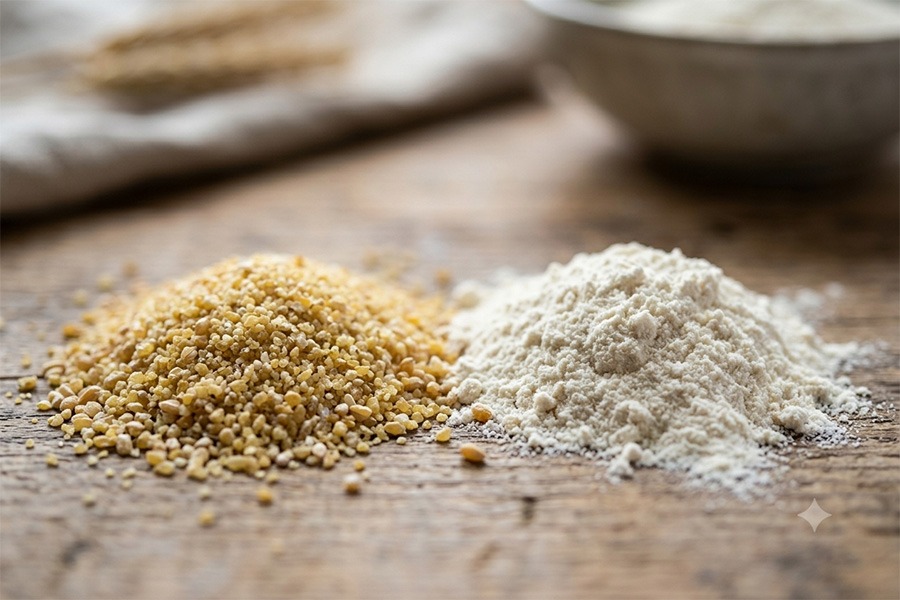
Semolina and Flour
Semolina is produced from wheat grains. When grinding the wheat, most of the grains are ground into fine flour, and a minority of them are ground into larger grains – this is semolina.
Semolina is described in biblical language as an expensive product, “You adorned yourself with gold and silver, and your clothing was of fine linen, silk, and embroidered cloth; you ate semolina, honey, and oil; and you became exceedingly beautiful and succeeded to royalty.” (Ezekiel 16:13).
Even today, the Hebrew phrase “Soltah U’shmanah” (its semolina and its oil) is used to describe wealth and prestige.
- Compare semolina to flour: observe the color.
Touch the semolina and the flour – what is the difference in the feeling? Is there a difference in the smell? How do you think the difference between the semolina and the flour will affect the baking of the cake?
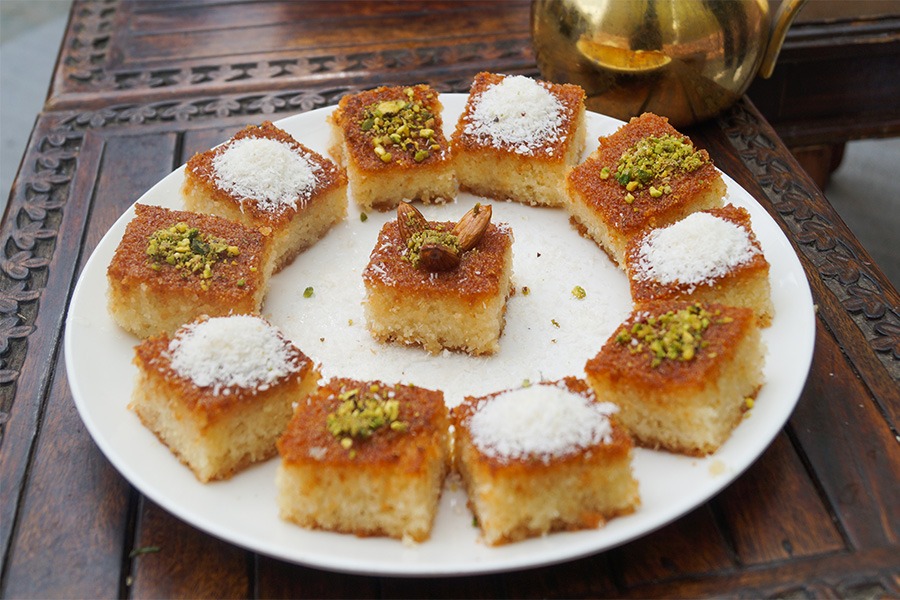
Basbousa
Preparing the cake
- Basbousa means sweet in Arabic.
Look at the recipe ingredients – which of the ingredients causes the cake to be sweet?
For the batter
\(\space\)
4 cups semolina
\(\space\)
Three-quarters of a cup of sugar
\(\space\)
1 cup coconut flakes
\(\space\)
2 packets vanilla sugar
\(\space\)
1.5 packets baking powder
\(\space\)
200g melted butter
\(\space\)
1 and a quarter cups buttermilk
\(\space\)
A pinch of salt
\(\space\)
Half a cup of raisins
For the syrup
\(\space\)
1 cup sugar
\(\space\)
1 cup juice
\(\space\)
1 tablespoon fresh lemon juice
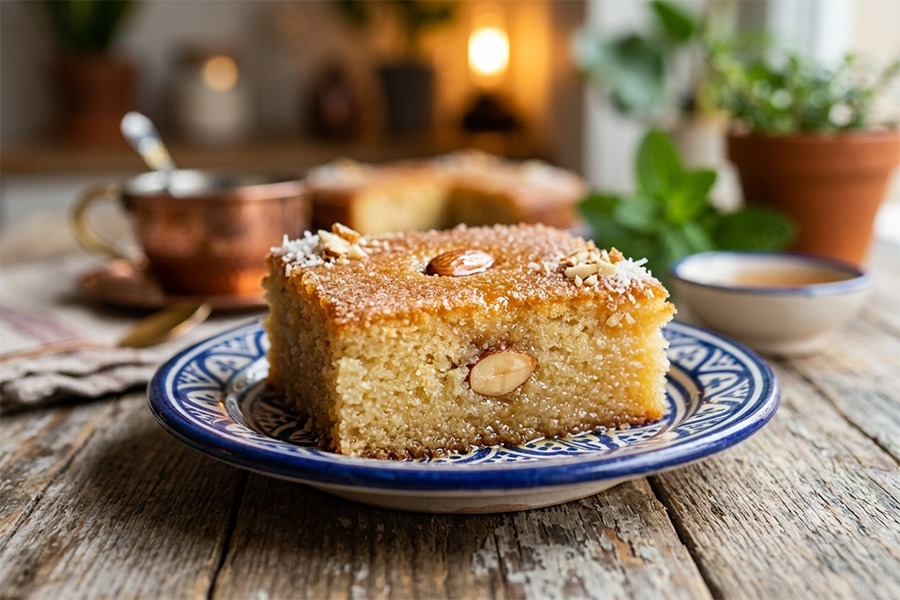
Instructions
- Mix all the dry ingredients together.
\(\space\) - Add the buttermilk and the butter and mix well.
\(\space\) - Pour into a greased pan and let sit outside for 10 minutes.
\(\space\) - Bake at 160°C for 40 minutes.
\(\space\) - Boil the syrup ingredients for 15 minutes.
Pour the syrup over the cake.
\(\space\) - Almonds can be scattered for decoration.