




Home \(\blacktriangleright\) Children and Youth Unit \(\blacktriangleright\) Arrows Website \(\blacktriangleright\) Music in Egypt \(\blacktriangleright\) Activity 1: Classics in Different Versions
Activity 1: Classics in Different Versions
This activity (by: Dr. Omri Ruach Midbar) is dedicated to classical Mizrahi music, through a prominent song performed by iconic female singers, such as Um Kulthum (the original singer) and Sarit Hadad (the modern version).
We will watch different performances and learn to compare them according to parameters such as musical instruments, vocal embellishments (vocal trills), outfits, and interaction with the audience.
The activity develops the children’s analytical and critical listening skills.
In this activity, the children will get to know the Egyptian song Inta Omri.
This activity is mainly aimed at exposing the children to music they might not be used to hearing, and to expand the musical repertoire from which they can derive enjoyment.
Try to remember this goal throughout the activity.
The Activity
Becoming familiar with and listening to the song Inta Omri
In the first stage, play about 10 minutes of the song Inta Omri performed by the singer Um Kulthum.
The playback can be repeated several times in the background during other activities of the children (playing, coloring, etc.), without directing them to consciously listen to the music.
After the children have gotten used to the new music and perhaps know parts of it, you can tell them that this music belongs to an Egyptian singer and talk with them a bit about the name of the song.
The song “Inta Omri” (إنْتَ عُمْرِي) begins with the sentence “You are my life, whose morning begins in your light.”
The song is complex to understand, but it can be seen that the central idea of the song is found in the opening sentence, which tells of a beloved who illuminates the life of the singer/poet.
This idea can be developed a bit with the children, asking them what they think is meant when it is said about someone that they are like a light in our lives or a light for us.
Any answer is good. It is recommended to respond positively to the children’s answers and perhaps even add additional answers of our own, as adults.

Um Kulthum
Family performance of a musical piece
To make the music endearing to the children, and so that they get to know it a bit more, it can be suggested that the family perform it through singing and dancing.
While the music plays in the background, family members can use various percussion instruments (from a pot and a spoon to a tambourine), and for those skilled at playing, even various string instruments.
Dancing by family members can add a lot to the experiential dimension, especially if various accessories are used, such as ribbons tied to the hand, scarves, or colorful dance clothes.
Comparative visual and musical analysis: Um Kulthum and Sarit Hadad
After the children have become acquainted with Um Kulthum’s performance of the song “Inta Omri” (“You Are My Life”), you can tell them that there are other singers who like to sing the song, and that you want to play for them a singer with a beautiful voice who likes to sing the song whose name is Sarit.
At this stage, Sarit Hadad’s performance of the song can be presented to them (found on YouTube).
After watching Sarit Hadad’s performance, the children can be asked for their opinion on this version (on this occasion, it can be explained to the children that every time a song sounds different, or is performed differently, it is identified as a new “version”).
After receiving feedback from the children, a conversation can be developed with them regarding the similarity and difference between Um Kulthum’s version and that of Sarit Hadad.
The suggested parameters for comparison are:
The length of the segments, the musical instruments, the vocal embellishments, the clothing, the movement and facial expressions of the performers on stage, the involvement/participation of the audience, the communication between the singer and the audience, and the like.
It is important to be attentive to the comparison parameters raised by the children, to cooperate with them, and to add your own to them.
The next time you want to repeat this activity, you can choose Zehava Ben’s version and compare it to the two previous versions.
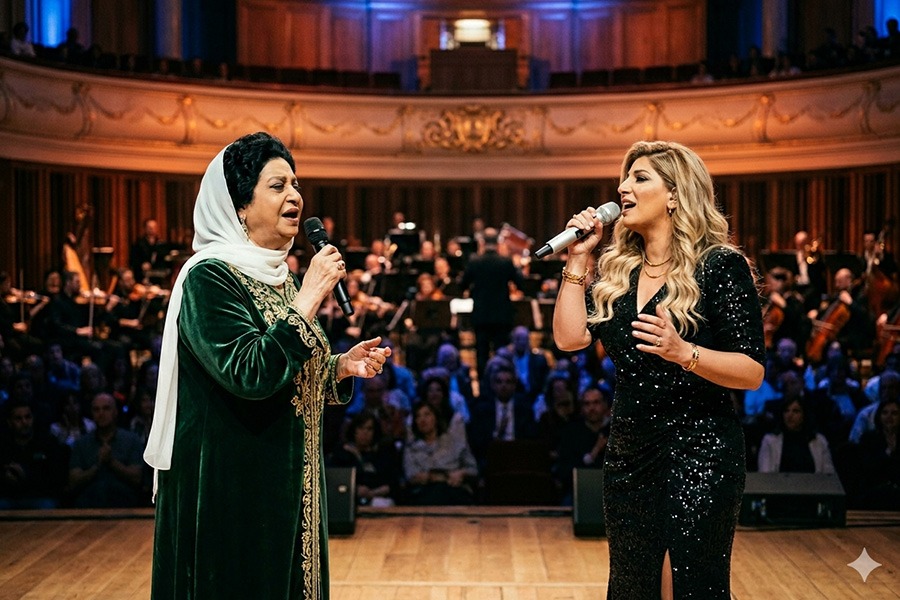
Um Kulthum and Sarit Hadad