




Home \(\blacktriangleright\) Children and Youth Unit \(\blacktriangleright\) Arrows Website \(\blacktriangleright\) Museums in Egypt \(\blacktriangleright\) Activity 2: Games and Toys
Activity 2: Games and Toys in Antiquity
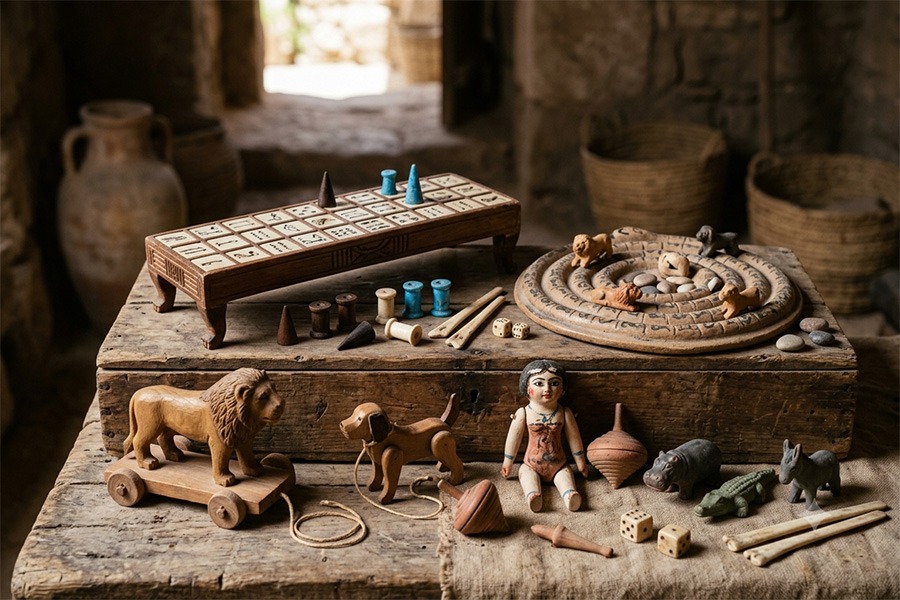
The following activity (by: Hadas Netzer Dagan) is based on observing the exhibits located in cabinet number 51 on the second floor of the Hecht Museum at the University of Haifa. All the exhibits are archaeological findings that were used as games and toys in antiquity.
Viewing the exhibits constitutes an opportunity for the children to imagine and think about what the daily life of children in antiquity looked like.
Thinking about dimensions of similarity and difference, between the lives of children in ancient Egypt and those of children today, allows making the display content accessible to the children’s world and turning it relevant to their world and fields of interest.
The Activity
- Observe the exhibits in cabinet number 51 with the children and try to imagine what each exhibit was used for.
\(\space\) - Check the ideas you raised together regarding each exhibit against the list of exhibits in the display case.
\(\space\) - Try to imagine what the daily routine of the children who played with the toys displayed in the case looked like:
- what was their daily schedule?
\(\space\) - What did they engage in? (worked, studied, played, etc.)
\(\space\) - With whom did they play (and with whom not – who was allowed to play with whom)?
\(\space\) - What did they look like? (clothing, hair, typical appearance for boys and girls).
\(\space\) - What did their home look like?
\(\space\) - With whom did they live and where did they keep their belongings?
\(\space\) - Were these characteristics of childhood identical for boys and girls in antiquity?
- what was their daily schedule?
- Suggest that the children draw the figures of the boys or girls they envisioned.
\(\space\) - Read the book “Cleopatra’s Story” by Adèle Geras to the children
- Check if the reality described in the book is similar to or different from the answers you gave to the questions asked in the previous section.
\(\space\) - Try to think about the meanings associated with living in a society with a class division as described in the story, in which boys and girls are obligated to work according to the class into which they were born, and their life path is predetermined.
- Check if the reality described in the book is similar to or different from the answers you gave to the questions asked in the previous section.