

Home \(\blacktriangleright\) Children and Youth Unit \(\blacktriangleright\) Arrows Website \(\blacktriangleright\) Symbols of Egypt \(\blacktriangleright\) Activity 1: Geography and Main Sites
Activity 1: Geography and Main Sites
This activity (by: Roni Gonen – Eiron) presents the Republic of Egypt, its structure, and main historical sites.
Egypt is located in the northeastern corner of the African continent.
It borders the Mediterranean Sea and the Red Sea.
Its neighbors: in the northeast – Israel, in the northwest – the Palestinian Authority, in the west – Libya, and in the south – Sudan.
The area of the Egyptian Republic is 1,002 million square kilometers.
Its population numbers 78.8 million people, consisting of Egyptians, Bedouins, and Nubians.
Despite its large area, most of its population is concentrated in the Nile Valley.
The capital city of Egypt is Cairo.
It is the largest and most densely populated city in Africa and the entire Middle East.
The Nile River crosses Egypt and empties into the Mediterranean Sea. Its length is about 6,700 km and it flows from south to north, through ten different countries.
In rainy years, the Nile would overflow its banks and flood entire areas, while in drought years, the amount of water in it was not enough for the residents.
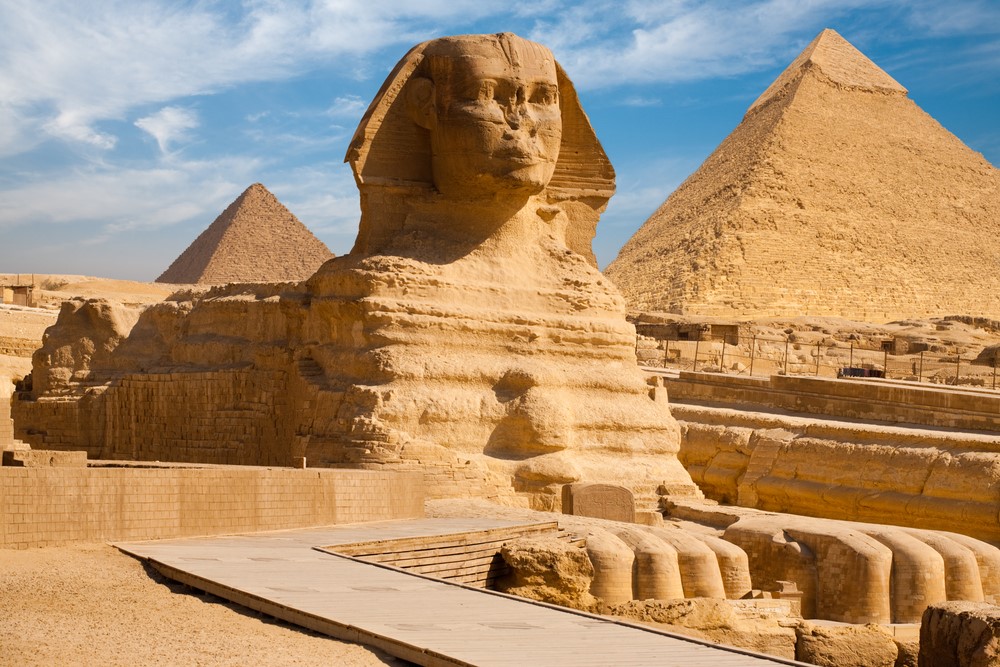
The Great Sphinx and the Pyramids
The Great Sphinx is a giant statue of a mythical creature with a lion’s body and a human head, and it stands at a strategic point as if protecting the pyramids behind it.
The pyramids are among the largest structures built by human hands and constitute a symbol of the cultural wealth of ancient Egypt.
There are many reasons for the unique structure of the pyramid.
One reason is their shape, which represents the primeval mound from which the world was created according to Egyptian mythology.
Another reason is the depiction of the spreading of the sun’s rays.
Contrary to popular belief, the pyramids were not built by slaves, but by professional builders who lived near the site.
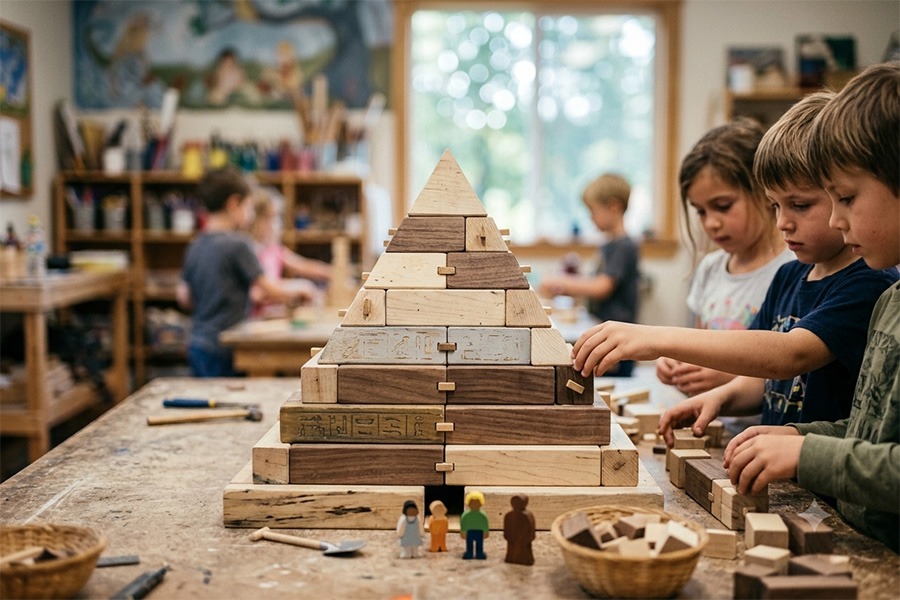
The Activity
- Experiencing the construction of a pyramid.
Different squares and triangles can be prepared from Bristol board or cardboard to try to create different pyramids.
\(\space\) - The geometric bodies can be unfolded and the net sketched together on Bristol board.
Fold, decorate, and create colorful pyramids.