




Home Page \(\blacktriangleright\) Children and Youth Unit \(\blacktriangleright\) Games for Flexible Minds \(\blacktriangleright\) Odd One Out
Games for Flexible Minds: Odd One Out
🔍
Activity Flow
Identifying the different item in a group based on various and changing criteria.
How to play?
Step 1: Presenting the group:
Present the group (or a single child) with a set of four items—three of which share some common denominator, and one item that does not.
Step 2: Finding the pattern (mental fixation):
Ask the children: “Who is different among the four, and why?”
At this stage, the children will identify the item according to the most obvious criterion.
Encourage them to explain the rule they found (“The car is different because it is not a vegetable,” “The banana is different because it is not blue”).
Step 3: Challenging flexibility (cognitive shifting):
After the child has found the first solution, set the challenge of cognitive flexibility:
“Very true! Now… can you find a way in which the second item is the one that is different? What makes it distinct from the other three?”
Step 4: Changing criteria:
The children are required to abandon the previous rule and invent a new, original rule that fits a different item as the “odd one out.”
The goal is to prove that any item can be the odd one out, as long as a logical criterion is found.
Required materials
Cards or pictures (drawings, illustrations) of familiar items, or use real objects. It is also possible to play without objects, simply by mentioning them by name.
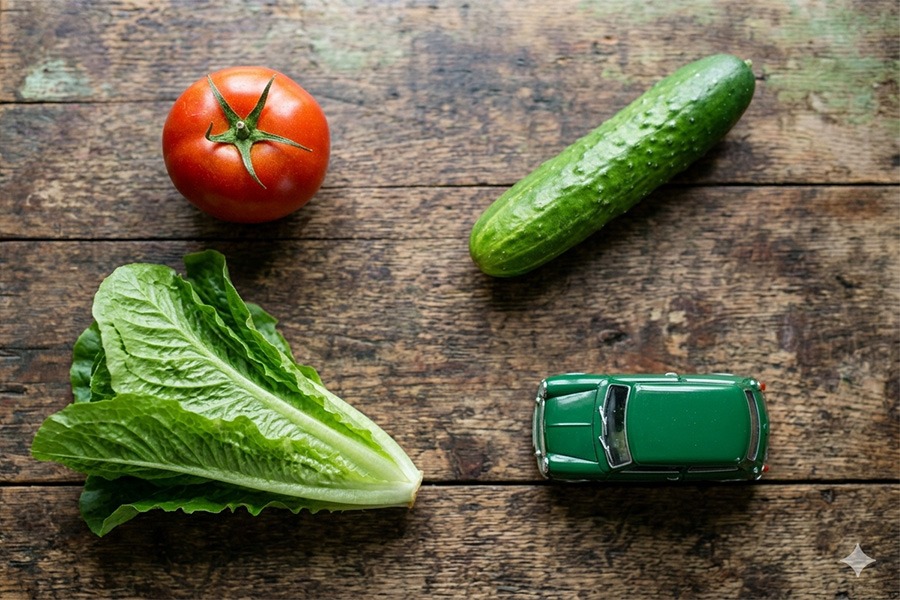
Examples for the activity
Who is different among the following options:
Banana 🍌 Ball ⚽ Circle ⭕ Moon 🌙
Possible answer 1 (material/use):
The banana is different (the other three are round).
Possible answer 2 (location/source):
The moon is different (the other three are usually found on Earth).
Clouds ⛅ Rain ⛈️ Glass of water 🍹 Faucet 🚰
Possible answer 1 (natural/man-made):
The faucet is different (the other three are water or natural phenomena).
Possible answer 2 (state of matter):
The clouds are different (solid/gaseous, the other options represent liquid water or water sources).
Happiness 😊 Laughter 😆️ Sadness 😢 Crying 😭
Possible answer 1 (emotion/expression):
Laughter is different (it is an external expression, while happiness and sadness are emotions, and crying is a response).
Possible answer 2 (category):
Happiness is different (the other three represent a negative/neutral action or emotion).
Blue 🔵 Pencil ✏️ Pen 🖊️ Marker 🖍️
Possible answer 1 (color/tool):
Blue is different (it is a color, while the other three are writing tools).
Possible answer 2 (tool type):
The pencil is different (the only writing tool that does not contain ink).
Father 👨🏾 Mother 👩🏼 Daughter 👧🏽 Son 👦
Possible answer 1 (family role):
The father is different according to gender/adult role criteria – he is the only man who is not a “child” (adult male).
Possible answer 2 (domestic role):
The mother is different according to a specific domestic role criterion – she is the only one responsible for cooking at home (or any other role that exists in the family).
.
Possible answer 3 (birth order):
The daughter is different according to birth order criteria – she is the only child who was not born first (if she has an older brother).
Possible answer 4 (hobby/interest):
The son is different according to hobby/interest criteria – he is the only one who understands computer games (or any other area of interest that distinguishes him).
Note: The goal is not the single “correct” answer, but the ability to switch the perspective and find a new connection that justifies any choice.
Yellow car 🚕 Football ⚽ Banana 🍌 Lemon 🍋
Possible answer 1 (shape/material):
The car is different, as the other three are round.
Possible answer 2 (color):
The soccer ball is different, as the other three are yellow.
Possible answer 3 (use/taste):
The lemon is different, as the other three are sweet or not sour.
Note: Can be presented as objects.
Red triangle 🔺 Blue square 🟦 Green circle 🟢 Red square 🟥
Possible answer 1 (shape):
The triangle is different, as the other three are squares or circles (not triangles).
Possible answer 2 (color):
The blue square is different, as the other three contain a red color or a red shape.
Possible answer 3 (combination):
The green circle is different, as it is the only item that is neither red nor a square (the ability to generalize and negate two features together).
Note: Can be presented as objects.
Bird🦜 Airplane 🚀 Kite 🪁 Fish 🐠
Possible answer 1 (mode of movement):
The fish is different, as the other three can fly in the sky.
Possible answer 2 (living/inanimate):
The bird is different, as it is the only living creature in the group (the other three are objects or creatures not defined as birds).
Possible answer 3 (source/nature):
The airplane is different, as the other three do not require engine fuel to move or stay in the air.