

דף הבית \(\blacktriangleleft\) היחידה לילדים ונוער \(\blacktriangleleft\) אתר חיצי”ם \(\blacktriangleleft\) מוזיקה בתרפבות אפריקה \(\blacktriangleleft\) פעילות 1: המקצבים של אפריקה
Activity 1: The Rhythms of Africa
In this activity (by: Dr. Omri Ruach Midbar), we will introduce the rhythmic characteristics typical of African music: syncopation, polyrhythm, and ostinato.
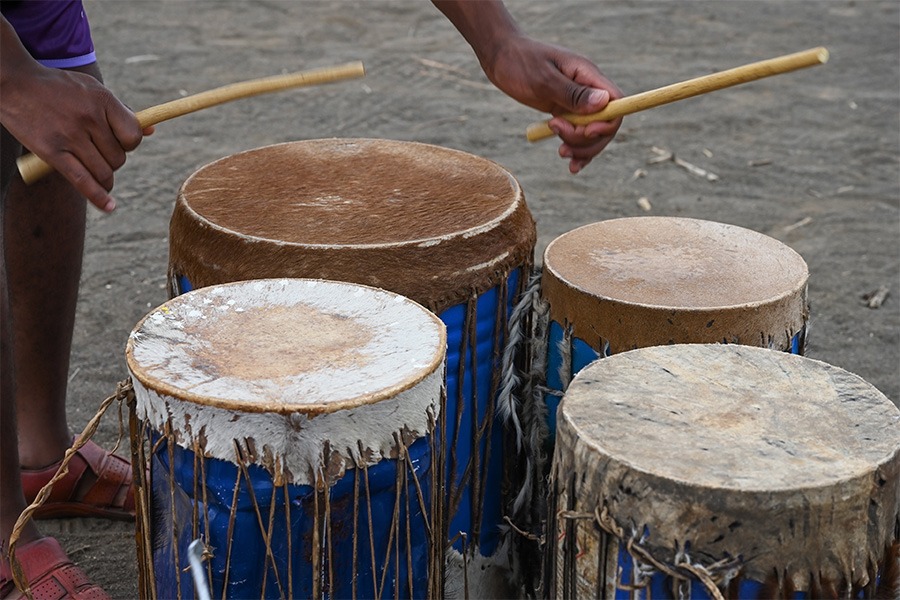
As is well known, in Tarzan’s free time (when he wasn’t going to after-school activities), he loved to drum on drums, tree trunks, and stones.
There were different types of drumming that he loved.
You can ask the children if they want to learn to drum like Tarzan.
Now is an appropriate time to teach the children some of the prominent characteristics of Sub-Saharan African rhythms: syncopation, polyrhythm, and ostinato
(use the terms only after the children have experienced and come to know the rhythms through the experiential experience).
The Activity
Syncopation
Syncopation is a rhythm where the emphasis in the rhythm is in a surprising place, which disrupts its regular flow.
We will learn about the basic syncopated rhythm through a two-stage experience:
- At first, parents are asked to drum a 4-quarter rhythm at a slow speed. That is, a pattern of 4 equal beats that repeats itself over and over (in a loop).
While the parents continue to beat, the children will be asked to join in and strike the first beat of the pattern every time it appears.
\(\space\) - In the next stage, the rhythm becomes syncopated, as the children are asked to drum the second beat.
\(\space\) - Children who feel comfortable with the activity can experiment with a different type of syncopation:
where they strike the pattern of 4 beats, but they permanently omit the third one.
This is the place to draw attention to the importance of “silence” in African music.
Polyrhythm
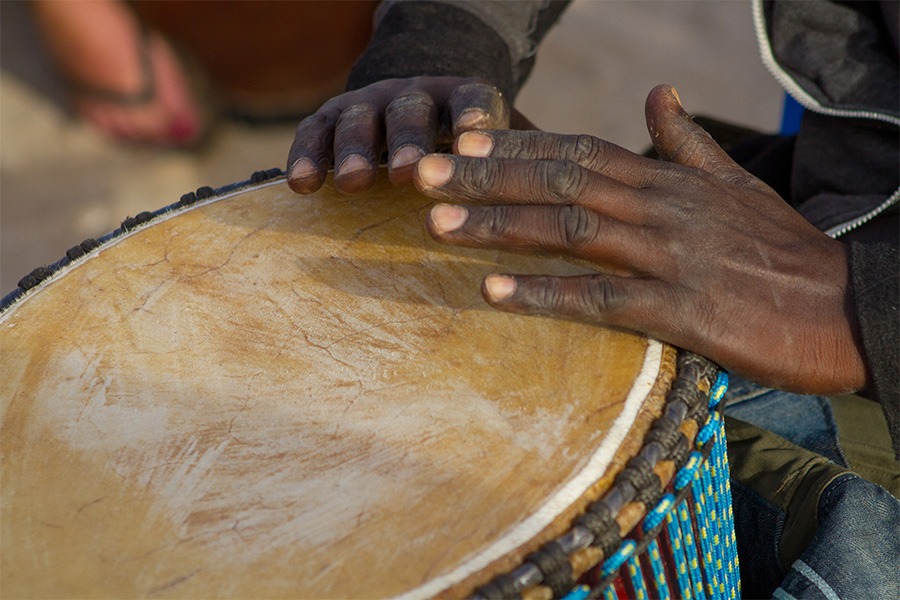
Polyrhythm is actually more than one rhythm.
For someone who has not experienced it, striking two types of rhythms simultaneously is a challenging task, even for parents—consider yourselves warned.
First, parents need to acquire the skill before they pass it on to the children.
- Parents are asked to strike a pattern with 4 equal beats with one hand, and simultaneously 3 equal beats with the other hand. Both hands start the pattern together every time.
\(\space\) - After parents master polyrhythmic striking, they can teach the child to strike one rhythm, on top of which they will strike another rhythm.
The challenge for the children at this stage is not to get confused, and to persist in striking the rhythm.
\(\space\) - You can stop at this stage, but advanced drummers can switch roles with their children.
Eventually, the children can strike both rhythms simultaneously, each with a different hand.
Ostinato
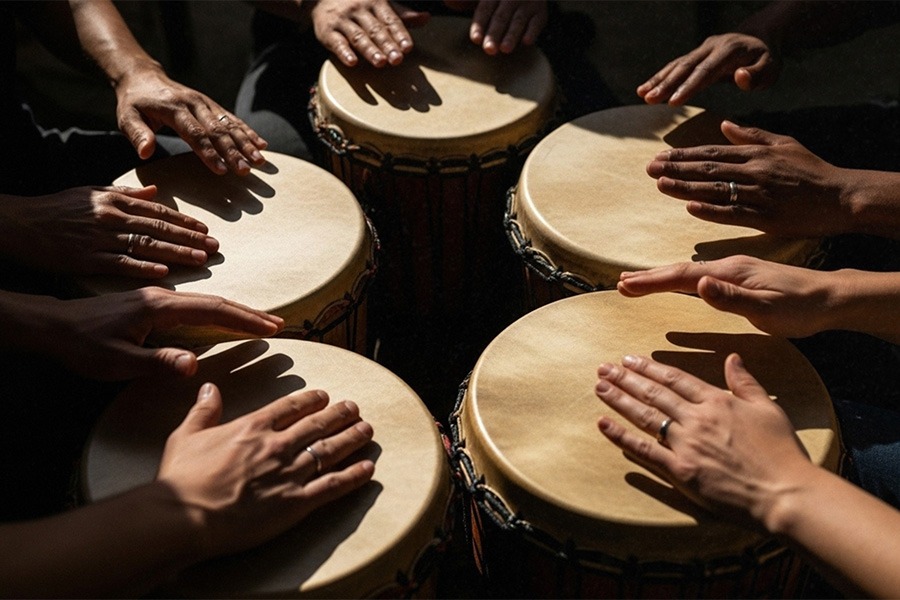
A melodic or rhythmic pattern that repeats itself over and over.
On top of this pattern, additional rhythms and melodies are played.