

דף הבית \(\blacktriangleleft\) היחידה לילדים ונוער \(\blacktriangleleft\) אתר חיצי”ם \(\blacktriangleleft\) מוזיקה בתרבות אפריקה \(\blacktriangleleft\) פעילות 2: כלי נגינה אפריקאים
Activity 2: African Musical Instruments
What is a “thumb piano” and how can a drum express ‘peace’?
In this activity (by: Dr. Omri Ruach Midbar), we will get to know the traditional musical instruments of Africa up close – the kalimba, the djembe, and the agogo.
We will learn about their structure and cultural significance, and even watch how they integrate into a fascinating cross-cultural encounter.
Tarzan also used to play various musical instruments, sometimes together with the other animals
(you can let your imagination run wild and add details about Tarzan’s adventures and the musical instruments as you wish).
The kalimba, the djembe, and the agogo are different types of percussion instruments.
The first is based on plucking metal strips with the fingers,
the second on drumming with the hands on a drum,
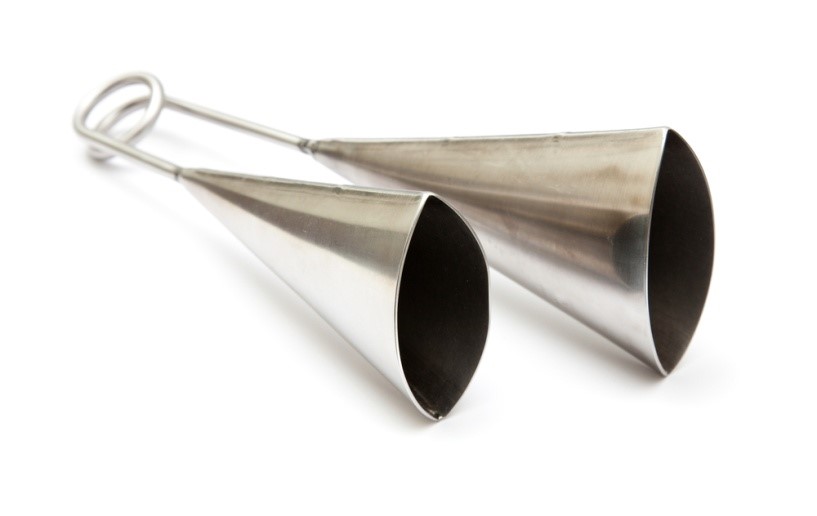
and the third is a bell that can be struck with sticks.

The Activity
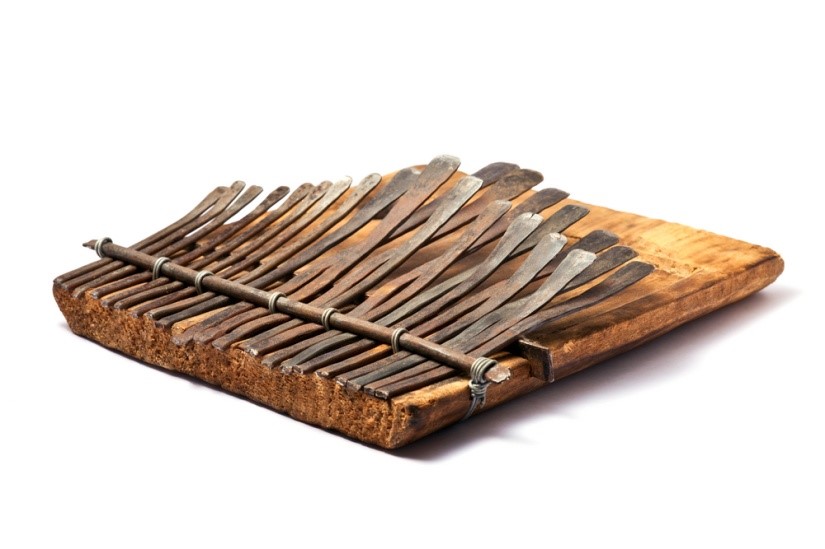
Kalimba
- Belongs to the percussion family, and is also called a “thumb piano,” although it can be played using more than just the thumbs.
\(\space\) - You can listen to various examples of kalimba playing: as a solo and in a band on the internet.
\(\space\) - For the brave among us, a homemade kalimba can be prepared.
You can involve the children in the process of making the musical instrument, the materials it is made of, the dilemmas in the various stages of preparation, and the choice of solutions.
The preparation may take several days.
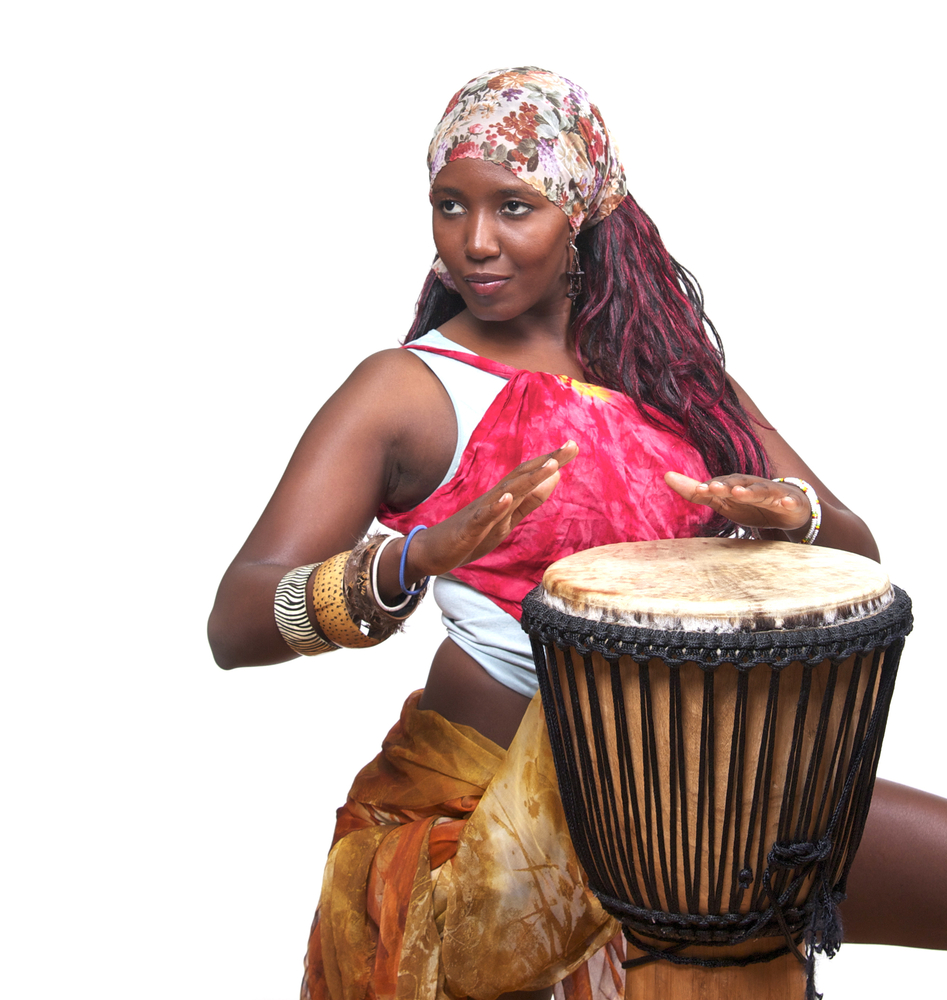
Djembe
- The etymological meaning of the word djembe is “peace.”
You can ask the children how they think playing the djembe can bring peace (for example, between children who are fighting) or expresses peace.
\(\space\) - A joint viewing of a scene from the movie “The Visitor,” in which Tarek, a professional drum player, teaches Walter to play the djembe.
The scene can be experienced through different aspects: a cross-cultural encounter, dealing with difficulty in a learning process (playing and learning in general), the interaction between thought and feeling, openness and inhibition, and of course the musical aspect.
\(\space\) - After the joint viewing, experiences can be shared and the conversation can be channeled into the appropriate aspects.
For example, you can ask the child what they think of Walter? On the one hand, he is fearful and perhaps even shy, but on the other hand, he is brave because he tries something that is difficult for him and ultimately overcomes it and even enjoys it.
\(\space\) - It is also worth discussing the three aspects learned in Activity 1: syncopation, polyrhythm, and ostinato, and how these are expressed in the musical piece.
Balafon
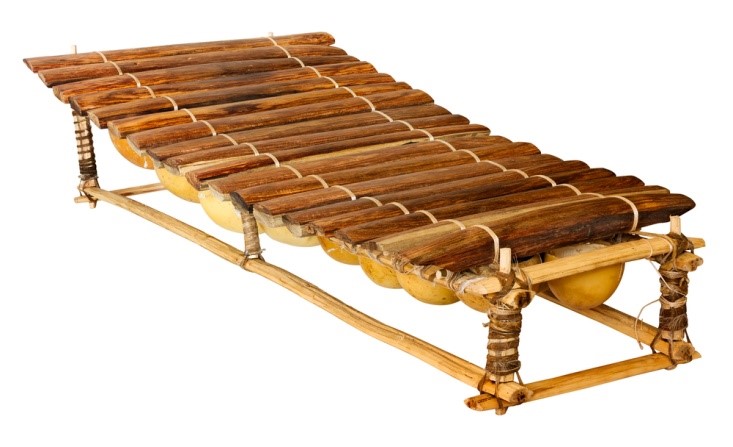
- According to the tradition of the Mandinka people in West Africa, the original balafon (the “Soso Bala”) is considered a sacred instrument that represents unity, history, and a connection to roots.
\(\space\) - You can ask the children how they think the unique sounds of the balafon, produced from wood and gourds, can connect people and tell a story without words.
\(\space\) - To get to know the instrument, the children will experiment with creating a personal “resonance box” using their own bodies and a variety of objects in the room, to understand how the gourds underneath the balafon amplify and change its sound.
\(\space\) - You can ask the children which materials around us can resonate, and how the size of an object or space affects the volume of the sound (for example, speaking into a cup versus speaking into a large box).
Agogo
The agogo is a traditional African bell, which can appear in various sizes and usually produces two pitches (high and low). It serves as one of the core instruments for maintaining the steady rhythm (ostinato) in African music.
- Rhythmic listening: Search online for video or audio clips of African bands using the agogo (you can search under the term “Agogo bell rhythm”).
Listen carefully and try to identify the role of the agogo: it does not play a solo, but rather maintains a simple rhythmic pattern that repeats itself over and over.
Try to isolate its sound from the overall texture.
\(\space\) - Since a real agogo is not always available, an instrument can be improvised to mimic its two sounds. You can use two different kitchen utensils: for example, a wooden spoon on a glass cup (high sound) and the same spoon on an empty tin can (low sound).
Ask the children to strike the rhythmic pattern of the agogo they identified using the improvised instruments, making sure to consistently alternate between the high and low sound.
Emphasize the importance of accuracy and consistency – the agogo is the rhythmic anchor of the band!