

דף הבית \(\blacktriangleleft\) היחידה לילדים ונוער \(\blacktriangleleft\) אתר חיצי”ם \(\blacktriangleleft\) ספרות בתרבות אפריקה \(\blacktriangleleft\) פעילות 2: ספרות העם האפריקאית
Activity 2: African Folk Literature
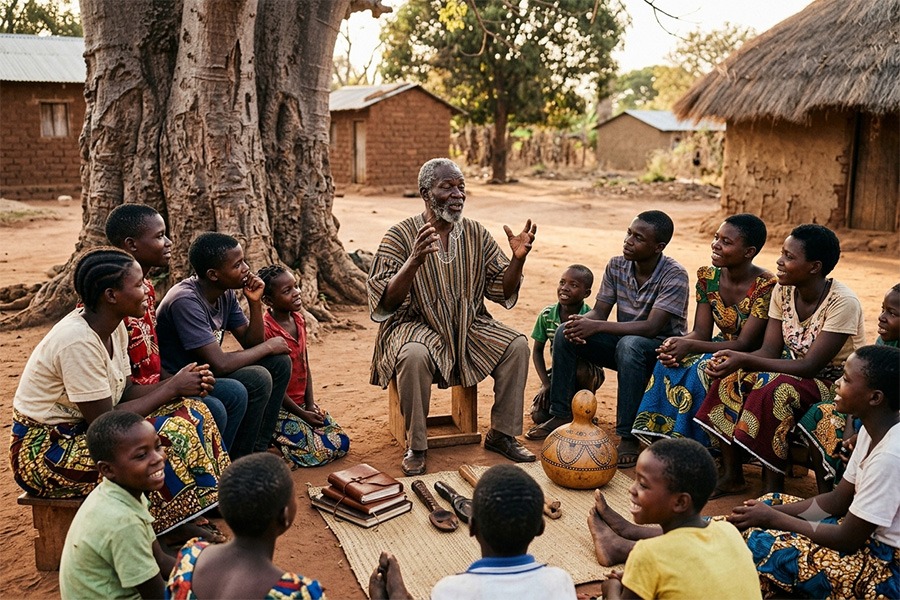
African folk literature is rich with thousands of animal stories from all across the continent (the savanna, the jungle, the rivers), which are referred to as fables or folktales. Additionally, in Africa, music and rhythm are an inseparable part of stories and of life. Musical instruments like the darbuka and the xylophone accompany celebrations, dances, and also folktales. In this activity (written using Gemini 2.5 Flash AI), we will learn to listen to the rhythm of the story, play music ourselves, and dance a “rain dance” that will connect us to nature and legends.
Suggestions for Stories to Use in the Activity
You can choose a story like “The Wren and the Camel” – a Kabyle fable originating from North Africa. The idea in the fable is how something small (like a wren, which is a small bird) feels in front of something very large (like a camel). The rhythm and movement activity allows for a game of contrasts in movement: small and fast movements versus slow and heavy ones, a fast and soft rhythm (small percussion instruments) versus a slow and strong one (the sound of a darbuka).
Alternatively, you can choose the fable “How the Chameleon Lost the Race,” originating from East Africa. The central idea is that speed (of a rabbit or a cheetah) is not always what is important. Wisdom and a trick (by the chameleon) can win. (From this, it can be understood that the chameleon did not actually lose the race, contrary to what is stated in the story’s title). The movement activity places emphasis on rhythm changes in movement: a fast rhythm and a strong stomp of the fast animal; a slow rhythm, stealthy movement, and color changes of the chameleon (transitioning between the sounds of different percussion instruments).
The Activity
- Reading a short African poem or story with a clear rhythm (for example, a story about the animals in the savanna).
The parents tap a steady rhythm (like drumming on a darbuka) during the reading.
The children are asked to imitate the drumming with their hands on their knees every time they hear a specific word (for example, the word “lion” or “rain”).
\(\space\) - This time, create a dance for the story.
The parents read the short poem/story again.
The children move around the room according to the story and the rhythm:
When the story speaks about animals – imitate them (a cheetah running, an elephant walking slowly).
When the story speaks about rain – perform a “rain dance” (clapping hands, stomping feet, making rain sounds).
\(\space\) - Conversation with the children: How does the story sound and feel when it is accompanied by music and movement?