




דף הבית \(\blacktriangleleft\) היחידה לילדים ונוער \(\blacktriangleleft\) אתר חיצי”ם \(\blacktriangleleft\) ספרות בתרבות צרפת \(\blacktriangleleft\) פעילות 3: עכבר העיר ועכבר הכפר
Activity 3: The Town Mouse and the Country Mouse
The fable presents two different lifestyles.
After reading the fable, you can manage a discussion about the advantages and disadvantages of each lifestyle and draw the differences between the city and the country, while referencing the message of the fable.

The Activity
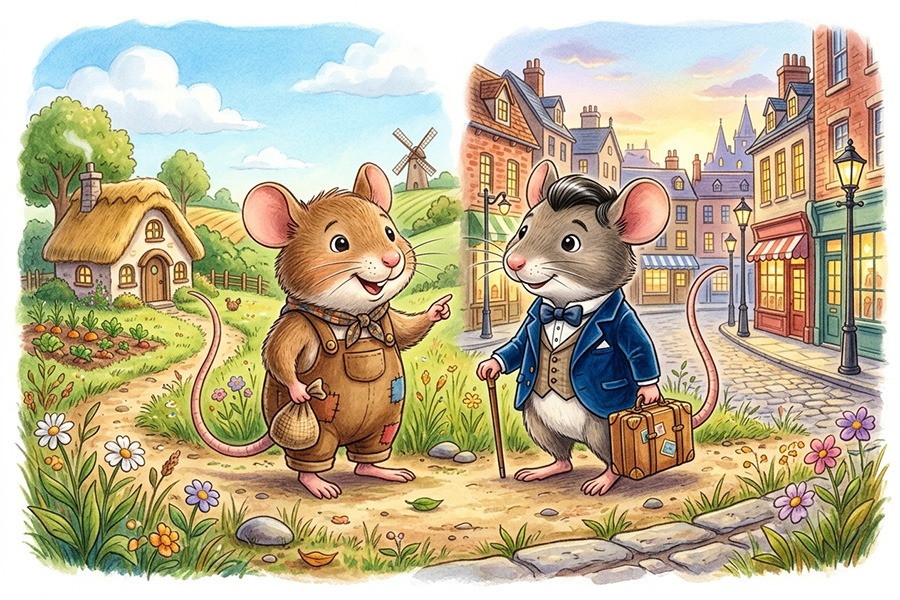
- Reading the fable The Town Mouse and the Country Mouse
\(\space\) - What are the differences between an urban and a rural environment?
\(\space\)
Background for discussion:
The “struggle” between life in the city and the country began around the Industrial Revolution in the 18th century.
During this period, social and economic changes occurred. These changes created advancements that enabled the mechanization of various processes in the fields of agriculture and industry.
Their impact on the lifestyle at the beginning of urbanization: people moved from the suburbs to urban centers.
The revolution had many social consequences that included changes in social classes, which created two central classes – the bourgeoisie (professionals) and workers (most of whom were poor).
\(\space\)
Another process that occurred as a result of the transition to industrial manufacturing was the exploitation of children and women for work in factories in order to help support the family.
\(\space\)
One of the products of the revolution was the development of the social work profession, which was required due to the need to provide a response on three different levels – employment, family, and society.
Gradually, the state took responsibility for helping weak populations as part of a welfare policy.
- Drawing the two different environments – urban and rural, while answering the question: what are the characteristics of each environment?
\(\space\) - Discussion regarding the term ecological footprint, which means: everything a person does affects their near and distant environment.
\(\space\)
Background for discussion:
Human impact on Earth can be calculated as their ecological footprint. That is, the area required to sustain a person’s (or a country’s) standard of living over time:
Total fertile land used directly for human resources: agricultural grazing and forest + sea area used for fishing + built-up land + “energy” land (the forest area needed to absorb the carbon dioxide emitted as a result of energy consumption) + land for preserving biodiversity (such as nature reserves).
\(\space\)
Which way of life is more harmful to the environment and why?
A discussion can be created with arguments for and against each place of residence from various aspects.
\(\space\)
How can we reduce the environmental damage we create in our place of residence (in a practical way)?
Suggest ideas for inventions that will reduce the use of environmental resources.
Suggest steps that can be taken in the local authority where we live, within the framework of the home and kindergarten.