




דף הבית \(\blacktriangleleft\) היחידה לילדים ונוער \(\blacktriangleleft\) אתר חיצי”ם \(\blacktriangleleft\) מוזיאונים בתרבות צרפת \(\blacktriangleleft\) פעילות 5: מסע אל עולם האספנות
Activity 5: A Journey into the World of Collecting
Does your child also have a collection of stones, stickers, or dolls?
The human tendency to collect items of value, preserve them, and display them is an experience familiar to children from an early age.
This activity (by Hadas Netzer Dagan) deals with the human tendency to collect items of value, preserve them, and display them. The definition of what constitutes a valuable object and what value is attributed to it changes from place to place, from time to time, and from person to person. This tendency is what lies at the foundation of the museum’s existence as an institution containing collections of exhibits that are preserved and displayed to visitors. In France, private collections that belonged to kings and the nobility became national collections after the Revolution.
In this activity, we will explore the children’s personal collection and compare it to magnificent collections in France, while examining how French museums sort and display their collections in a unique way.
The origin of the term “museum” is in the ancient Greek word Μουσεῖον, which means “shrine of the Muses.” That is, a place where the muse dwells and where one can receive or feel inspiration.
The tendency to collect objects, defined as treasures, mainly characterized nobles whose wealth allowed them ownership of valuable items, and the size and grandeur of their homes allowed them to be displayed in a way that served to glorify the homeowners’ name and wealth.
In the modern era, museums gradually became institutions engaged in preserving heritage and presenting it to the public. With the development of the field of museology, a separation developed between different types of museums specializing in displaying collections of exhibits in distinct fields of knowledge: art, archaeology, science, culture, and more.
During the 20th century, museums and their leaders began to see their purpose not only in preserving heritage but also as institutions for education, research, learning, and leisure.
This short historical description is presented for your review – the parents – so that you can tell the children about it, but not before we conduct an activity with them that will help them connect to the experience of a museum through their own tendency to collect objects, preserve them, and display them.
The Activity
Exploring My Collection
This activity is intended for children who have a collection of their own.
If your child has a collection, ask them to present it to you.
Discuss the following questions with the child:
- How did it come into the child’s possession? What is it?
\(\space\) - Dwell on each and every item – what is its meaning (in general and in the eyes of the child),
its value to him or her,
is it exchangeable and under what conditions.
\(\space\) - Is it a complete or partial collection – what items are missing from it, who defines what a complete collection is, how can it be completed (purchase, trade, finding)?
\(\space\) - How does the child feel about being the owner of such a collection – does it cause a feeling of enjoyment, pride, respect, or perhaps other emotions?
\(\space\) - Do other children have collections similar to or different from this one?
\(\space\) - What does he or she like to do regarding their collection when meeting other children – do they like to display it to guests visiting their home, play together with the different items, trade items between them, lend items to a friend?
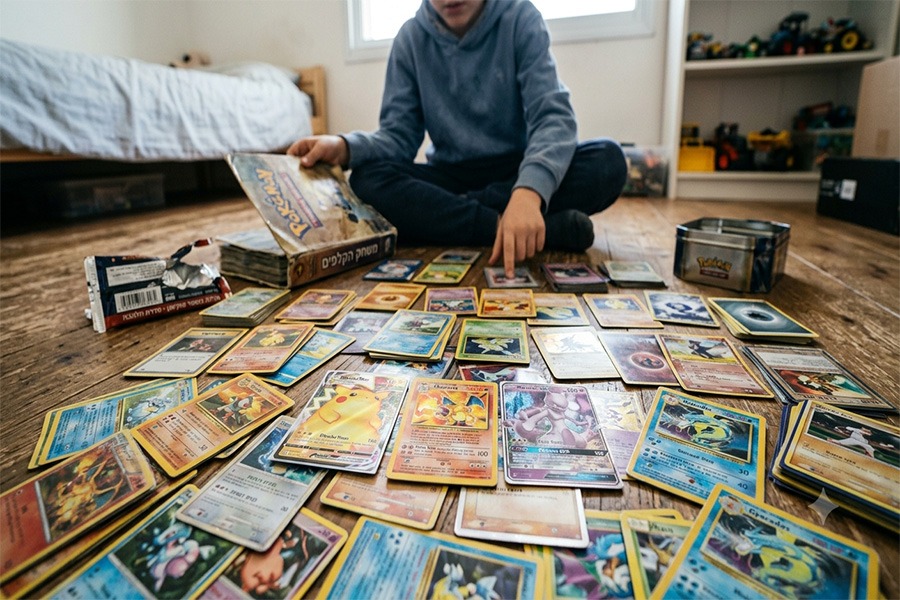
- How is their collection kept in their room – is it in a way that ensures its preservation or its display to others?
\(\space\) - Is anyone allowed to touch their collection, who, and under what conditions?
\(\space\) - What might someone who visits the child’s room and views the collection learn about its owner – what do they love, what are they interested in, what is important and valuable in their eyes, how do they keep and care for their collection?
\(\space\) - What would they want someone who visits their room and looks at it and the collection in their possession to think about them?
Following this conversation, you can tell the children about the nature of the museum as a place where various objects are collected, preserved, and displayed to the general public.
You can connect the children’s answers to the questions detailed above with the content detailed above regarding the history of museums.
In addition, try to think with the child if he or she is satisfied with the way their collection is kept and displayed in their room, and whether they would like to change anything in this regard: change the location of the collection, its appearance, or store it in a place where it will be better preserved.
Creating a Collection
This activity is intended for children who do not have a collection of their own.
- Think with the children about something you can collect together: seashells from the beach, special stones from a nearby field, wild flowers (that are not protected) (*), and more.
Go out with the children to the site you choose for the collection.
\(\space\) - Sort what you collected according to criteria you decide on together: size, color, where they were found, rarity, etc.
\(\space\) - Think with the children how it would be right to keep and display the collection you created, considering the characteristics and size of the home, the scope and dimensions of the collection, elements you want to emphasize or conceal, the level of preservation required for the exhibits, and the desired degree of accessibility of the visitors and household members to them, as well as other aesthetic and practical considerations that seem significant to you for this matter.
In order to plan the display and learn about the ways exhibits and collections are displayed in museums, you can look at museum websites.
\(\space\) - When looking at the various display solutions with the children, try to find out with them what the characteristics of each solution are and what needs it meets (protects the product from touch or theft, highlights it, elevates it, illuminates it, and more).
Plan the collection display together with the child and execute it accordingly.
\(\space\) - Visit museum websites in Israel and around the world (and especially in France) with the children, to illustrate to them what a museum looks like and what the nature of its collections is.

(*) Drying Flowers
Wild flowers can be dried, if you choose to do so, to create a collection of dried wild flowers, which will be preserved for a longer time than fresh flowers.
\(\space\)
The instructions for drying the flowers are as follows:
- Flowers can be collected in the garden or field and dried between two sheets of newspaper pressed inside a thick, hardcover book. It takes about ten days for the flowers to dry completely.
\(\space\) - Afterwards, it is advisable to spray them with lacquer (for preservation). There are other ways to dry flowers. There is a substance called “silica gel.” This is a moisture-absorbing substance in the form of granules.
The flower is submerged in the substance for a few days in a closed box, and the substance absorbs the moisture and leaves the flower in its natural shape.