

Home \(\blacktriangleright\) Children and Youth Unit \(\blacktriangleright\) Arrows Website \(\blacktriangleright\) African Cuisine \(\blacktriangleright\) Activity 2: Baked Sweet Potato
Activity 2: Baked Sweet Potato
A Historical Journey: Sweet Potatoes, Millet, and the Evolution of Nutrition in Africa
How did climate and geographical changes affect what people eat in Africa?
This activity sheet (by: Dr. Galit Botzer) takes us on a journey through time, from hunting and gathering to cultivating grains and root vegetables.
We will discover millet, which is adapted to dry regions, and the sweet potato, which starred in the rainforests.
We will learn about the foundational principles of African nutrition and get an idea of how to prepare a similar sweet potato dish.
What did humans eat in ancient Africa?
In ancient Africa, humans were hunters or gatherers and fed mainly on wild vegetables (roots and leaves) supplemented by meat, fish, and eggs.
They also gathered wild seeds and used palm oil.
Around 7,000 BCE, people in North Africa began raising cattle imported from Asia.
Humans milked the cows and produced yogurt and cheese.
Foundational principles of nutrition in Africa:
- People in Africa domesticated wild crops that grew in their area or in neighboring regions.
- Starting from ancient times, animals and plants were imported to Africa from neighboring continents.
Agricultural crops, and therefore human nutrition, depend on the climate and soil characteristics of each region.

What do people eat on a continent that is largely desert?
Around 6,000 BCE, the climate changed and the Sahara Desert gradually took over the grasslands of Africa.
The Sahara Desert is the largest hot desert in the world.
All North African countries hold part of the Sahara’s territory: Algeria, Chad, Egypt, Libya, Mali, Mauritania, Morocco, Niger, Sudan and Tunisia.
As the Sahara Desert expanded, obtaining food became more difficult and Africans began to cultivate food.
In North Africa and Egypt, the cultivation of wheat and the making of bread became the basis of life (see expanded information in the activity on Egyptian cuisine).
In addition, barley, lentils, and chickpeas were grown in North Africa. These crops were domesticated and cultivated by humans.
The diet was based on pita-like bread, porridges, and soups.
In ancient Egypt, barley was used to produce beer, and during this period, goats and sheep also began to be imported from Asia – a step that changed the dietary habits of the region.
Alongside these developments on land, the inhabitants of North Africa continued to fish in the sea, with tuna being one of the main fish caught.
In southern Africa, south of the rainforests, stretch large grassy plains. Here too, the Kalahari (which is similar to a desert but less dry) expanded.
But since there were few people in this area, they did not turn to agriculture. Instead, they raised cattle and made dairy products.
Millet

One of the oldest foods known to man.
Millet can be grown in dry areas where there is no fertile soil.
In South Sudan, a pita-like bread called Roti (pictured) is baked from millet.
Underground food
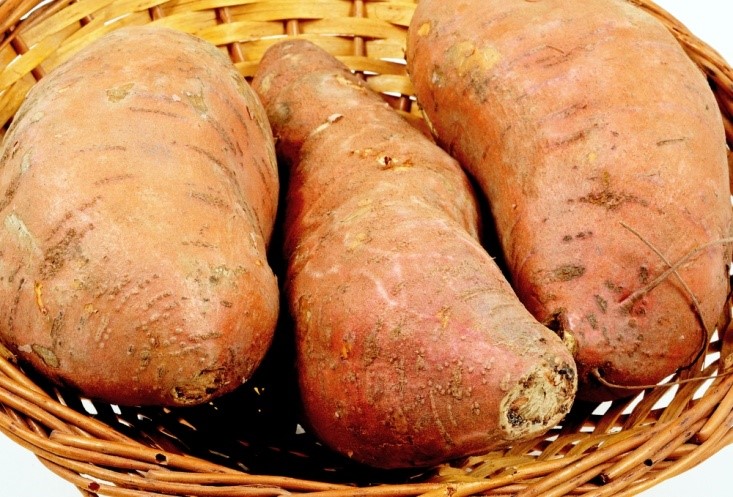
In the rainforests of South Sudan, it was not possible to grow any type of grain, as these areas are too humid. Here, people began to cultivate root vegetables, especially sweet potatoes.
The sweet potato is a root vegetable. The root is rich in starch and sugar.
In West Africa, a dish called Eto is made from sweet potatoes. They boil sweet potatoes, mash them, and add eggs and palm oil.
In the past, this dish used to be served as an offering to the gods.
The Activity
Introduce the children to the sweet potato.
Present it whole and peeled.
A similar sweet potato bake can be prepared:
Mash cooked sweet potatoes, add eggs and oil, season with salt, arrange in a baking pan, season, and place in the oven.
A kind of tasty pie/mash is obtained.
It may be difficult for children to peel or cut a sweet potato, but they will be able to participate in mashing the cooked sweet potato.