




Home \(\blacktriangleright\) Children and Youth Unit \(\blacktriangleright\) Arrows Website \(\blacktriangleright\) Museums in Egypt \(\blacktriangleright\) Activity 1: Egyptian Mythology
Activity 1: Egyptian Mythology Through the Museum Lens
The activity (by: Hadas Netzer Dagan) deals with becoming familiar with Egyptian mythology.
We will get to know the Egyptian gods and the story of the creation of the world according to Egyptian mythology.
In this way, we will allow the children to get to know the stories and characters that stand behind the archaeological exhibits displayed on the second floor of the Hecht Museum at the University of Haifa.
The Activity
Background for parents
Egyptian mythology is a collection of religious stories that developed over about 3,000 years in ancient Egypt.
The stories include many myths and a variety of beliefs and customs.
Mythological stories of nations deal with fundamental questions of human existence such as:
How was the world created?
Where did we come from and for what purpose?
Why are people born and die and what, if anything, happens after death?
What is man’s place in the world and what are his links to nature and the animal world?
Why do people differ from one another in their traits, appearance, and destiny?
And many other different questions.
The mythological stories offer answers to these questions, and they are the basis for the beliefs, values, customs, rituals, and ways of life practiced among every nation.
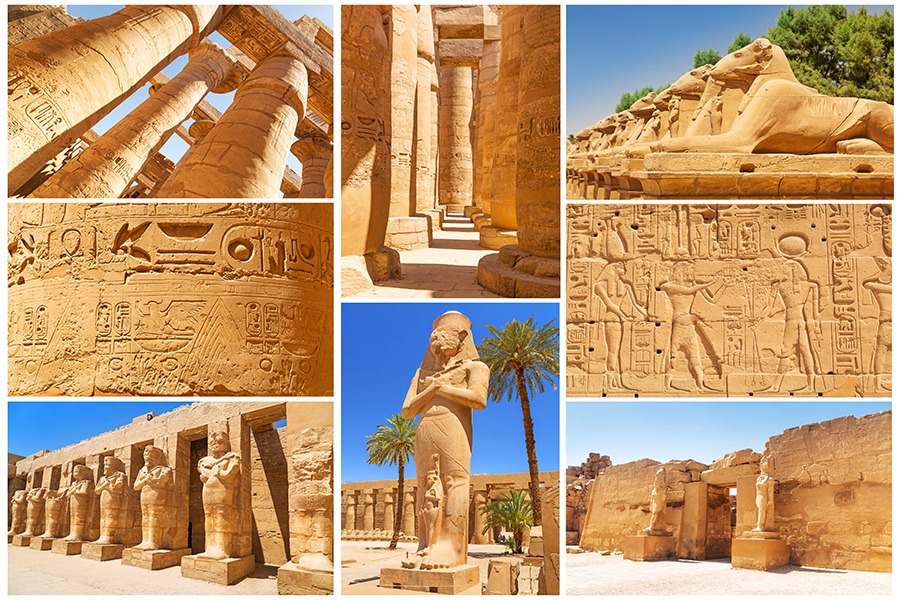
Like most myths of the world, the Egyptian stories also unfold the chronicles of various gods and supernatural creatures in the creation of the world, man’s place in it, and the links between them and the gods, and between the world of the living and the world of the dead.
Please note, in Egyptian mythology there is an extensive engagement with issues of life and death.
From our experience, on this topic, every parent has positions and red lines regarding their willingness to expose their children to it.
This is a complex question related to the worldview of the parents, the degree of readiness of the children to cope with topics of this kind, the degree of exposure of the children to the topic due to life circumstances, the degree of interest of the children in questions of this kind, and more.
You are invited to make use of the stories subject to your worldview, your red lines, and the needs and capabilities of your children, as you know and understand them.
- Read the story of the creation of the world according to Egyptian mythology to the children (recommendation: “Ancient Egypt – Myths and Legends of the World’s Peoples”, S. Friedman Publishing), or according to any other story of your choice.
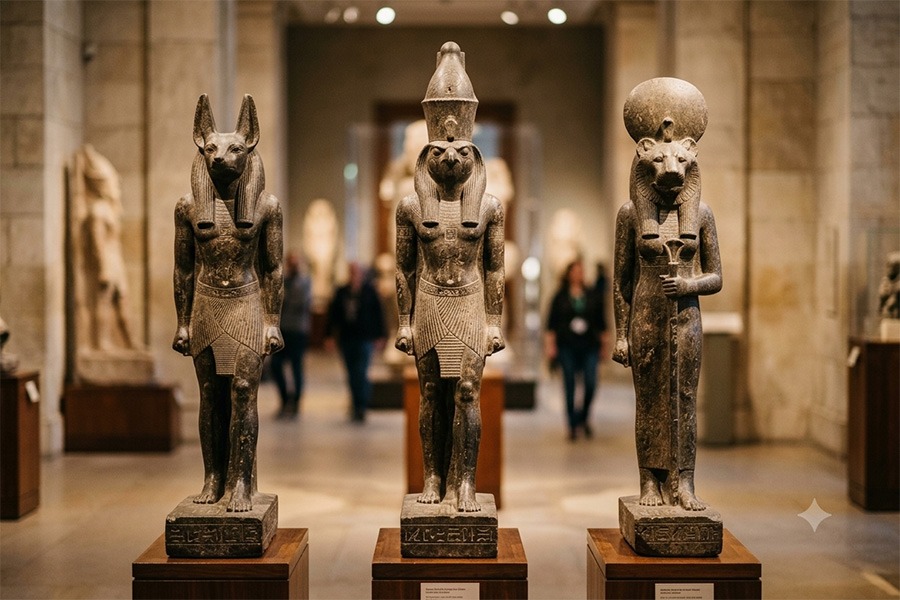
\(\space\) - Search together for pictures and descriptions of the various gods and goddesses, their traits, and the fields in which they “specialize.”
\(\space\) - Suggest that the children choose a figure of one of the gods, goddesses, or characters. Search for additional information about it.
Look together at the figure and talk with them about the following questions: why did they choose this figure? What is there in her or him that speaks to them, and why?
\(\space\)
A personal “gallery” of pictures of gods, goddesses, and characters from Egyptian mythology can be created, colored and designed according to the children’s choice and interpretation.
(Pay attention to the fact that through the creative process, children can emphasize dimensions they like and blur dimensions they do not like in the various figures.
This too is a way to cope with the question of which dimensions in Egyptian mythology it is right to expose your child to.)
Take the pictures of the gods with you for a visit to the Hecht Museum at the University of Haifa and look for exhibits dealing with them in the display. When you find such exhibits, you can talk with the children about the questions below:
\(\space\)
A. What is the exhibit in or on which the figure is found?
What was the exhibit used for, and what is the meaning of the combination between the practical role of the exhibit and the meaning of the mythological figure it carries?
\(\space\)
B. What is the similarity and/or difference between the picture / illustration we downloaded from the web and the exhibit? What do you think are the reasons for the difference?
(This is the place to talk about:
various variations of representations of figures,
the differences between a picture / illustration and a relief or statue,
the degree of preservation of ancient objects,
the dimensions of the exhibit in reality compared to how it is perceived in the imagination in light of the mythological story, and more).