

Home \(\blacktriangleright\) Children and Youth Unit \(\blacktriangleright\) Arrows Website \(\blacktriangleright\) Music in China \(\blacktriangleright\) Activity 1: Two Chinese
Activity 1: Two Chinese
In this activity (by: Dr. Omri Ruach Midbar), we will turn a nonsense song into a linguistic adventure.
We start with humor with “Shnayim Sinim” (Two Chinese Men) – a song we all know, but this time we will hear it in surprising ways!
We will use the lighthearted song as a basis for a deeper exploration of language: we will break words down into the Kamatz, Chirik, and Segol vowels, and play a fun sound game that will show us how any word can be turned into a new musical creation.
The Activity
- In the first stage, the song can be sung while it is played in the background.
\(\space\) - After getting to know the song, the children can be asked if they noticed anything interesting about it.
\(\space\) - Afterward, it can be summarized that it is customary to sing one verse of the song several times, with each time being sung differently, based on a different syntactic vowel.
This is an opportunity to talk with the children about how words are composed of different vowels (Ah, Ee, Eh, Oh, Oo), which have different names (Kamatz, Chirik, Segol, Cholem, and Shuruk respectively.)
Shnayim Sinim
Shnayim sinim im kinor gadol,
Yashvu be’tzad ha’kvish ve’pitpetu be’kol gadol.
Ba shoter, geresh otam, ve’ze ha’kol,
Shnayim sinim im kinor gadol.
- After becoming familiar with the vowels, a word game based on recognizing the vowels can be played with the children.
The parents announce a word, the child chooses a vowel and pronounces the word according to the chosen vowel.
\(\space\) - After getting to know the basic version of the song and practicing singing it, Shlomo Gronich’s version of this song can be heard.
This version contains diverse musical styles that change at a fast pace, starting with rock, continuing with a cappella, and up to singing in a Hasidic style.
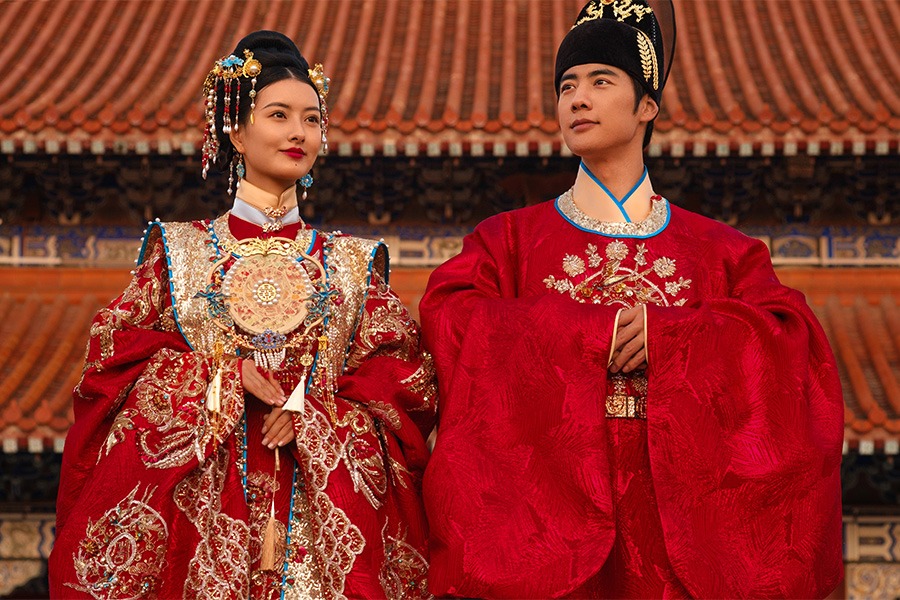
\(\space\) - At this stage, the children’s attention can be drawn to the fact that although the song is about two Chinese men, the music is not Chinese at all.
This observation will serve as a bridge to an experiential introduction to Chinese music in the following activities, in which the children will listen to Chinese music alongside dancing and a story reading.