



Home \(\blacktriangleright\) Children and Youth Unit \(\blacktriangleright\) Arrows Website \(\blacktriangleright\) Egyptian Cuisine \(\blacktriangleright\) Activity 2: The Secret of Legumes
Activity 2: The Secret of Legumes
This time, we embark on a journey following legumes – the true heroes of ancient and contemporary Egyptian nutrition.
In this activity, not only will we get to know the famous Ful Medames and Ta’ameya (Egyptian falafel), but we will also mathematically explore their importance. We will measure ingredients, calculate proportions, and prepare traditional ful dishes at home.
Are you ready to turn simple fava beans into a full meal?
The Activity
General background
Legumes have been used for thousands of years as a primary source of protein for the entire population, and they are just as important in Egypt today as they were in antiquity.
In this activity (by: Dr. Galit Botzer), we will explore the central place of fava beans in the Egyptian diet:
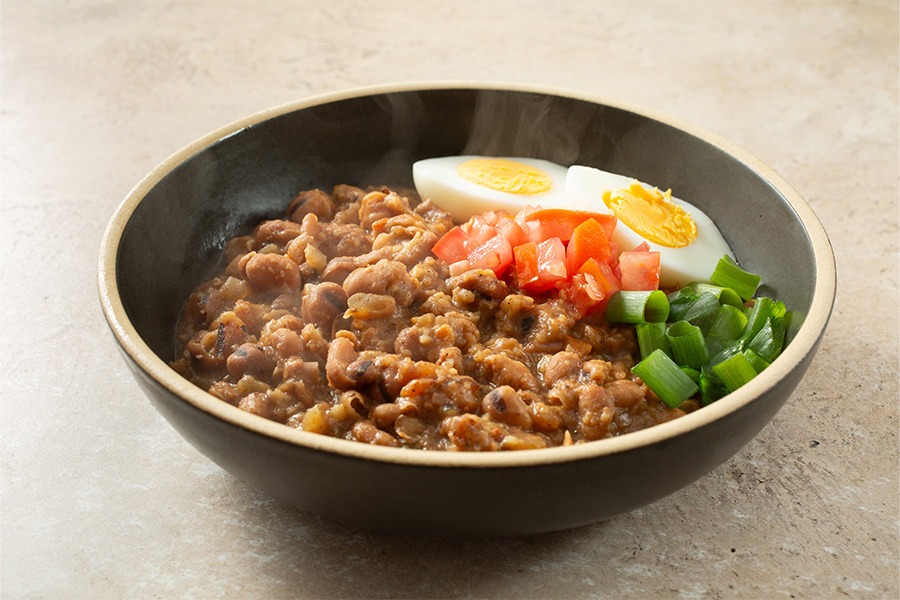
We will get to know “Ful Medames” – a popular national dish made of mashed fava beans.
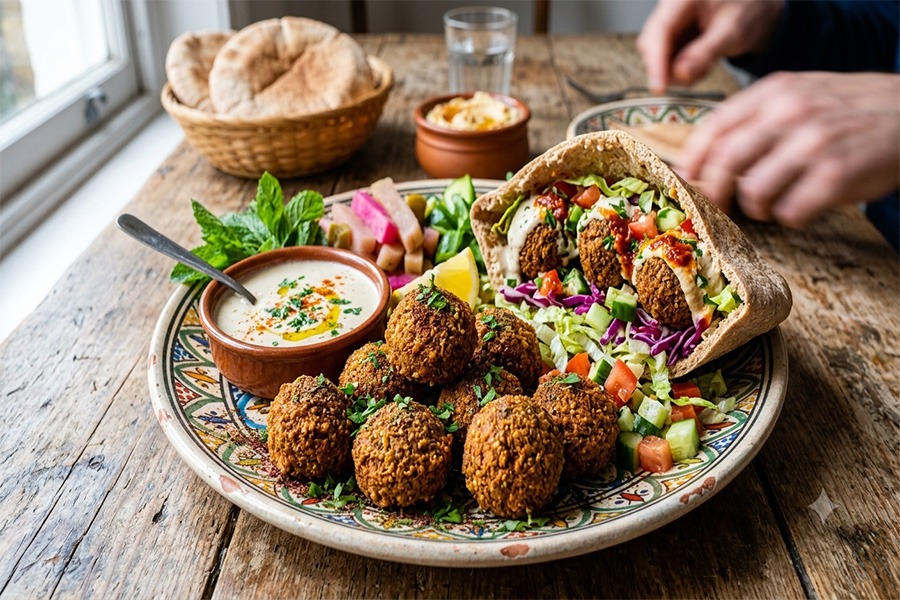
We will learn about “Ta’ameya” – none other than Egyptian falafel, which is also based on fava beans (unlike chickpeas, which are used to prepare falafel in other Arab countries).
Legumes also constituted a primary source of protein for the broad population in Egypt, and it remains so to this day.
Most Egyptians view Ful Medames (mashed fava beans) as their national food.
We will also learn about Ta’ameya (as falafel is called in Egypt), which is also made from fava beans, while in the rest of the Arab world, it is prepared from chickpeas.
Come discover how a little bit of fava beans can turn into a large and filling dish!
The Secret of Legumes
- Children can be shown what legumes are – beans, lentils, chickpeas, and especially fava beans (which is the national star in Egypt).
Legumes can be sprouted – soak in water overnight, and afterwards place in a sifter and wet every few hours until the appearance of the sprout.
Check how this activity illustrates the growth power of legumes.
\(\space\) - Read an explanation about the fava bean as a plant, and find the difference in the plant between fava beans (from which Ta’ameya is made) and chickpeas (from which falafel is made in other countries).
\(\space\) - Challenge yourselves with the children to prepare homemade falafel (“Ta’ameya”).
In Egypt, the traditional Ta’ameya is prepared specifically from fava beans, unlike Israeli falafel which is based on chickpeas.
Compare the flavors and the culinary differences.
\(\space\) - Discover the meaning of the name “Ful Medames” – “buried fava beans.”
This is its traditional cooking method: buried inside hot ash for hours.
Integrate a drawing or a dramatization of the ancient cooking form.
\(\space\) - Basic Ful Medames (mashed fava beans) can be prepared.
As part of the preparation, measure the quantity of dry fava beans against their volume after cooking – measure in cups and observe how a small quantity “grows” and turns into a filling meal.
- Why do you think fava beans are a “national food” in Egypt?
Examine its economic importance – how the low price of legumes allows them to serve as a main and filling food for a broad population.
\(\space\) - Challenge the children with simple calculations:
If we want to prepare a large portion that will suffice for the whole family, how much water or spices will we need (for example: if the quantity of fava beans is doubled, does the water and spices need to be doubled)? Explain that this exploration emphasizes the importance of ratios (proportions) in a recipe.
\(\space\) - Build a simple bar graph showing the amount of protein in 100g of fava beans, compared to 100g of other foods (chickpeas, meat, etc.).
Emphasize that this activity illustrates the nutritional and economic role of legumes as a cheap and nutritious alternative to meat in the Egyptian diet.