




Home \(\blacktriangleright\) Children and Youth Unit \(\blacktriangleright\) Arrows Website \(\blacktriangleright\) Museums in France \(\blacktriangleright\) Activity 4: The Hecht Museum
Activity 4: The Hecht Museum in Haifa
Visiting a museum is an exciting experience, but it is very different from looking at pictures on the internet. The following activity is designed to sharpen the differences between imagination and reality, and to allow the children to experience the museum in a deep and sensory way.
When the children are already familiar with the museum from the virtual tour of the major French museums (such as the Louvre and Orsay), it is time to check their expectations against reality at the Hecht Museum.
This activity (by Hadas Netzer Dagan) will focus on examining the differences between the pictures you saw of vast spaces in France and the real space in the local museum, the size of the exhibits, and the feelings the place evokes in you. We will compare the feeling evoked by a giant European art collection (like in France) versus an archaeology collection (like in Hecht).
The Activity
Upon your arrival at the museum, address the following points:
- Imagination vs. Reality: Look for the exhibits you chose on the museum’s website and check whether you correctly guessed their size.
Look at the museum space and try to think whether its dimensions are similar to or different from those you imagined from the pictures you saw.
\(\space\) - Sensory Comparison: Check what kind of feeling the museum space and its dimensions inspire in you.
Listen to the “sound” of the museum – is it more or less noisy than its external environment?
\(\space\) - Reflection and Questions: Try to find out what feeling is associated with staying in a place that is quieter than its surroundings.
Why do you think museums are sites characterized by relative quiet?
Are you familiar with other places that are less noisy than their surroundings?
Try to find out what feeling is associated with staying in a place that is quieter than its surroundings?
What are the advantages and disadvantages involved in conducting oneself in the relatively quiet environment of the museum?
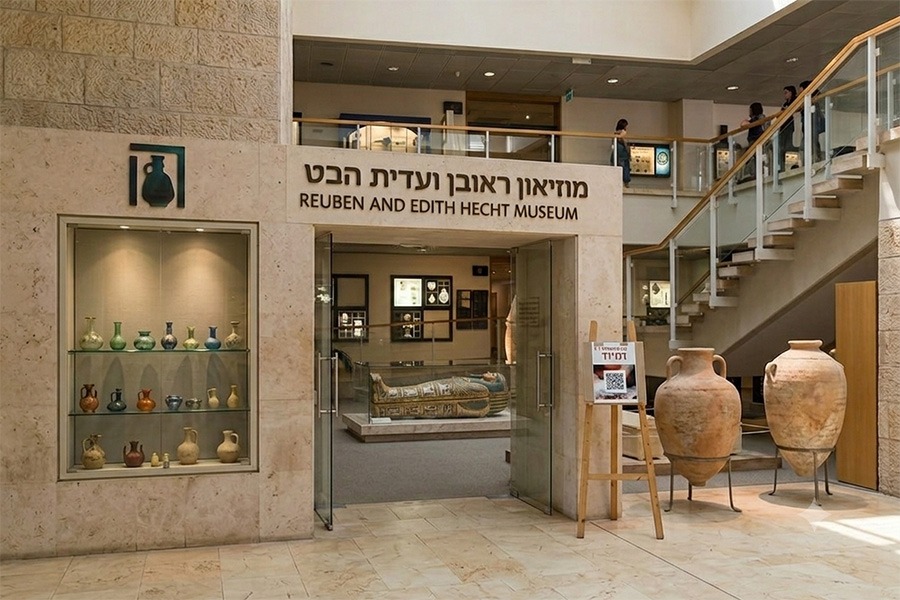
- Stories Behind the Exhibits: Encourage the children to choose one exhibit from the website that especially intrigued them.
Look for it in the museum and compare it to the picture you saw.
Together, make up a story about the exhibit: who do you think used it? Where did it come from? What did it see or go through?
\(\space\) - Art and Emotions: During the tour, ask the children to choose three different exhibits that evoke contrasting emotions in them (for example: joy, sadness, curiosity, or fear).
Try to understand together why each exhibit evokes a different emotion. Is it the color? The shape? The story behind it?
\(\space\) - Sketching and Illustration: Provide the children with a sheet of paper and a pencil.
Encourage them to choose an exhibit that interests them and sketch it on the spot.
This is an excellent way to notice the small details of the objects and develop observation skills.