




Home \(\blacktriangleright\) Children and Youth Unit \(\blacktriangleright\) Youth Enrichment Center (Archive) \(\blacktriangleright\) Course List (Archive)
Course List (Archive)
Below is the list of courses offered at the center during its years of operation (2008–2021).
As part of the studies, every student took two annual courses, with two lessons per session, each lasting approximately 75 minutes. At the end of the school year, a concluding conference was held where students presented final projects prepared under the guidance of the center’s staff.

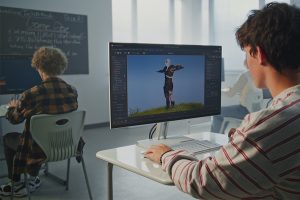
3D Animation
The course sessions will allow you to build a platform for a virtual world that combines animation and visual effects.
This is a professional first step into the field of animation and the acquisition of tools for creating video effects and advanced processing.
- During the course, you will build a virtual environment using leading advanced software and new techniques.
- You will acquire knowledge and empower skills relevant to the future world, which will allow you to break the boundaries of creativity and imagination.
Art: "Brushstrokes"
During the year, we will embark on a fascinating journey through the history of art.
We will get to know different artists, their techniques, their way of working, and their masterpieces.
We will learn the basic concepts of the language of art in its various expressions, in drawing and painting.
We will be exposed to artists such as Dürer, Rembrandt, and more.
We will travel to the Renaissance and get to know the works of Leonardo and Michelangelo.
We will jump to the 19th century and learn about the Impressionists (Monet, Degas…) and the Pointillists (Seurat…),
We will continue to 20th-century art with Post-Impressionist painters (Van Gogh, Cézanne, Gauguin), to innovative painters – abstract (Picasso, Mondrian…) and we will get to know Israeli painting (Reuven, Tagger, Gutman).
We will get to know the diverse work of the artists and apply these techniques in class work:
Composition, perspective, light and shadow, symmetry, color coordination, different brushstrokes, and more.
During the year and at its end, the course students will present their work in an exhibition that we will open to the general public.

Archaeology: Secrets from the Past
- How do observation and analysis of remains found in excavation areas allow us to understand the past of human culture?
- What are the sensational discoveries revealed at excavation sites that shed a different light on past events?
Every past hides secrets. We try to trace these secrets with the help of archaeologists.
Archaeology is a science that attempts to reconstruct human history, from its origins to the present day. It deals with ancient peoples and civilizations and discovers how humans lived in those periods.
In the field, archaeologists conduct excavations to find various remains from days of yore, including objects left behind by ancient settlements in the ground.
In the course, we will trace these findings and try to understand how the observation and analysis of these remains, found in the excavation areas, allow us to peek into the past and understand the past of human culture.
The variety of findings is extremely wide and includes objects from the fields of architecture, stones, ceramics, bones, copper tools, beads, jewelry, and more.
All these teach us about man’s daily activities like cooking, agriculture, and construction on the one hand, but also about special activities like burial or ritual ceremonies on the other.
In this course, you are invited to experience and peek into the exciting world of the archaeologist, in light of sensational discoveries found all over the globe that have shed a different light on past events.

Survival Against the Forces of Nature
Earthquakes, volcanic eruptions, floods, giant fires, tsunamis, meteor collisions… and we are still here.
Throughout history (and even before), humans have dealt with nature, both calm and destructive.
In the course, we will learn about some of the forces of nature, how they really work and why, what stories were told about them, and what explanations were given for them in the past, about people and societies that dealt with the forces of nature in the past, and how experts recommend surviving them in the present.
After all this – including films, pictures, diaries, and surprises – we will experiment with our own challenging and creative activities:
What ways can we invent to survive the forces of nature?
Journey to the Human Brain
- How does our brain affect knowledge acquisition, memory, perception, and decision-making?
- What is the connection between the brain’s structure and its various functions, and what might go wrong along the way…?
The human brain is the most important and intriguing organ in the human body, causing us to move, think, feel, and essentially live.
Through it, we absorb information from the world around us, remember facts, faces, and events, make decisions, dare, and restrain ourselves.
Through it, we experience the world and also control our body with the help of the nervous system, and thanks to it, we ask questions about the world around us and use resources in our environment.
Despite this, sometimes it seems to have goals of its own, separate from ours. It forgets precisely when we want to remember, increases our heartbeat in excitement when we want to appear calm, and one cannot always rely on the world picture it constructs from the information absorbed by the senses.
In this course, we will try together to understand how the brain “thinks.”
First, we will understand how it is structured, what the role of each area is, and how it processes the information absorbed from the environment.
After that, we will learn how brain activity is researched and get to know tools for brain research, such as EEG, MRI, and fMRI.
In addition, we will be exposed to various research methods in neuroscience and learn about some of the leading studies in the field.
Join us on this fascinating journey.

Escape Rooms – The Challenge of the Challenge
- The challenge of the riddle – what makes a good question a challenging riddle?
- What made the escape room the number one game in the modern world?
Come learn to build the most challenging game there is – an escape room.
An escape room is a kind of adventure game where participants are locked in a room and are required to use various objects found in it to solve a series of riddles or decipher codes and, in the process, escape the room in a limited amount of time.
In life, we look for challenges that will interest and excite us, that will be difficult in a way that encourages motivation and perseverance, and most importantly, that will leave us with experiences and memories.
During the course, we will go on a journey behind the scenes of escape rooms, we will face various challenges, and this time we will develop the game that will provide us with interest and a challenge.
Dealing with challenges is a necessary condition for realizing thinking potential, and the riddles, in fact, reflect the thinking process.
Building the riddles will expose participants to topics from various fields and help them acquire high-order thinking tools that they can apply in various ways outside the course sessions.
The tasks to which the participants will be exposed will allow for the illustration of complex and abstract ideas that require different thinking skills, such as inventive and creative thinking, cognitive flexibility, and more.
The practical experience will allow for deepening, understanding, and application of topics from various fields, such as: sciences, art, technology, mathematics.
Such a multisensory, dynamic, emotional, and social learning experience is a unique opportunity for long-term deep learning.
And what else do you need to know in order to create an attractive escape room? You will discover that in the course sessions.

Window to Space – The Universe is Large and Vast
Science fiction – is it really still fiction?
The course will conduct an in-depth introduction to the universe in which we live, from dust particles to giant stars, from the solar system to galaxies.
We will understand how it all began.
We will try to understand what the universe is, what it is inside, and how big it is.
We will also get to know what are the scientific methods with which it is researched? What are comets, and how big are galaxies? What are galaxy clusters, and what is there more of: stars in the sky or sand on the seashore?
We will understand what the nuclear processes occurring in stars are.
Why do some stars, at the end of their lives, become white dwarfs, some become neutron stars, and some become a different type of star.
We will talk about the physics of the Big Bang and the expansion of the universe.
And finally, surely you are interested to know – what really happens in a black hole?
Also, during the course, we will deal with satellites, missiles, and the physics hidden behind their operation.

Particles, High Energies, and Astrophysics
- What is the connection between particles and stars?
- What was before the Big Bang, what is the beginning of all beginnings?
Each of us looks at the sky and wonders: what is the meaning of all this beauty? How does it work? What is the beginning of all beginnings?
These questions and many others have occupied man since the dawn of history, and since then, he has been looking for answers to the riddle of the world’s existence.
During the course sessions, we will be exposed to various theories that are at the basis of cosmology from its beginning to the present day. We will get to know models and research methods used in space research, learn about various phenomena and structures in space; from nebulae and the formation of stars to black holes, we will build comets and more…
Later, we will get to know phenomena related to radioactivity and deal with the structure of the nucleus, nuclear energy, alpha radiation, beta radiation, gamma radiation, in nuclear reactions like nuclear fission, and nuclear fusion, in an atomic bomb, a nuclear reactor, and a hydrogen bomb.

Mathematical Investigations: Hypotheses and Proofs
As in other sciences, in mathematics, one can discover properties of various objects based on experimentation and generalization of experimental results.
Engaging in mathematical investigation develops creativity-related thinking regarding the generation of new ideas and critical thinking regarding the testing of generated hypotheses.
In the course, we will investigate questions like: among all rectangles with a given area, what is the rectangle with the maximum area? In how many ways can a mouse reach the cheese? And more…

Scientific Thinking
The goal of this course is to strengthen the student’s research and scientific thinking skills, expose them to a variety of scientific topics beyond the school curriculum, and provide them with an opportunity to perform collaborative research tasks under the lecturer’s guidance.
We will open the course with an introduction to the world of science, through a review of scientific discoveries that have influenced humanity, such as the discovery of penicillin by Fleming or the development of the electric light bulb by Thomas Edison.
We will practice collecting, processing, and presenting information. We will also practice researching computerized simulations as well as interpreting and constructing graphs.
We will conclude the course by reading a popular scientific article and processing it for presentation through a lecture and poster at a scientific conference.

Tastes from the World of Construction and Architecture
Architecture is traditionally defined as the art of building, as a field dealing with the planning and design of spaces, and located in the range between art and building engineering.
Engaging with space can include the built environment as a whole at the macro level, down to the design of details at the micro level.
Architecture is a multidisciplinary subject that includes mathematics, science, arts, social sciences, environmental sciences, politics, history, philosophy, and more.
As Vitruvius defined it about two thousand years ago:
“Architecture is a science, which depends on many other sciences, and is adorned with many and varied learnings.”
In this course, students will be exposed to various aspects of the world of architecture and construction.
We will take a short journey through the history of architecture in the world, we will hold a multi-session planning workshop at the end of which each student will present the project they planned using cross-section plans and a model. We will meet and experience working with building materials by planning and executing a casting mold, preparing the mixtures and casting the element, we will experience building bridges from unconventional materials, and more.
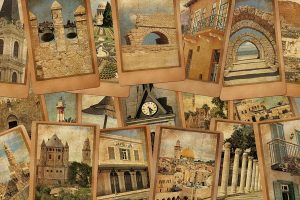
Masterpieces in Art
The “Mona Lisa”, Munch’s “The Scream”, Van Gogh’s “Sunflowers”, and Raphael’s “Madonnas” – these are works everyone meets and learns to recognize, even if they are not particularly interested in art.
These works appear on shirts and umbrellas, in caricatures, and in the news (when they are sold for a lot of money).
Getting to know the key works of Western art is part of the general education we acquire over the years, and at the same time, these works raise many questions.
Why are they famous and others not? Are they really “better” than other works? What is a good work? Who decides?
In the course, we will get to know some of these famous works, the superstars of the art world. We will learn about the work itself and its path to the status of a “super-work.”
We will learn about the artists and similar works by other artists, about the development of each motif in these works. We will observe the work’s influence on other works, in popular culture, and in other media (films, advertisements, studies, caricatures, etc.).

All the World's a Stage – Fundamentals and Language of the Art of Theater
Theater is an ancient yet current and useful artistic field.
In this unique art of the theater, the raw material is the human being: their body, their voice, their stories, their struggles, and their desires.
As a creative tool for personal and social human expression, theater also serves as a social art that examines, reflects, and critiques social issues, moral questions, and interpersonal conflicts.
In this course, students will experience the art of theater and the joy of creation through various aspects of the process of creation, performance, and analysis.
Together we will examine the art of theater in two parallel and merging tracks: an experiential, experiential, and creative track of learning acting, movement, theatrical use of the voice, stage design, and more; and a theoretical-academic track in which we will deal with the origins of theater, various theatrical styles, different perceptions of theater, and analysis of texts and plays.
In the course, students will acquire tools for understanding the art of theater, analyzing theatrical works and performances, managing informed discourse in the language of theater, and of course, creating and designing theatrical works of their own.
Together we will rediscover the art of theater and the secrets hidden within it.
Logic and Thinking Games
Logic is the science of reasoning; hence, during this course, we will develop our foundation of thinking with the help of several different logic tools.
First, we will learn about the three basic states in logic (tautology, contingency, and internal contradiction). After that, we will use these states to solve a variety of logic puzzles and get to know the concept of paradox.
Second, we will get to know the basic principles of set theory and use these principles to solve additional logic puzzles.
Third, we will get to know different groups of numbers, investigate them, and examine the relationships between them.
We will spice all this up with touches from the world of mathematical thinking games and the world of the history of mathematics, such as: solving mathematical problems in the rhetorical period, ancient riddles, finding sums of infinite series, and more.

Logic and Decision Making
- What is the connection between mathematics, logic, and pleasure?
- How can I win and when?
The terms “logic and critical thinking” go back to ancient times.
Logic and critical thinking served the Greeks as a tool for social criticism and for improving the human soul.
Later, starting from the 16th century, a century in which humanity witnessed the beginning of the Scientific Revolution, logic and critical thinking served as a central tool in the study of nature and the study of the inanimate.
In the twentieth century, logic and critical thinking accompanied the development of the theory that became the leader in the study of decision-making: game theory.
These three fields—the study of social processes; scientific research; and the study of the optimal strategy for decision-making—are those that will stand at the center of the course.

Introduction to Simulation Development
Learning the Matlab language as a tool for scientific programming, Matlab variables, conditions, and loops.
Using the graphics library.
Defining problems from the world of computer science, solving them, and presenting the solution while using the graphics library.
Executing a scientific project.

Introduction to Psychology – Secrets of the Mind
“When you change the way you look at things, the things you look at change.”
– Wayne Dyer
The main occupation of psychology is the study of the mind and understanding personality. How does the way a person perceives the world affect their thoughts and behavior?
In this course, we will learn about interesting psychological theories that touch upon each and every one of us.
Fascinating personality and social researchers like Skinner, Freud, Milgram, and Erikson will reveal to us secrets concerning human nature.
We will watch videos of famous psychological experiments and some of them we will even reconstruct during the classes, so we will also put ourselves to the test.
We will learn why, despite the fact that we are all different from one another, most of us will choose to behave in a similar way in the same situation, and only a few of us will succeed in going against social norms.
This course is dedicated to the study of the self and the society in which we live.

Mazes, Riddles, and Paradoxes
The world of mathematics harbors within it many interesting secrets.
The goal of the course is to cause students to uncover these secrets and understand them.
This way will arouse interest, motivation, and pleasure in learning mathematics and will contribute to the development of mathematical thinking among the course participants, while enriching and deepening their mathematical knowledge beyond the school curriculum.
During the course, students will be exposed to unconventional mathematical problems, will deal with mathematical and logical paradoxes, and will experiment with investigations and generalizations.
In order to solve the problems, the students will have to translate them into mathematical language and find a suitable, and not necessarily conventional, way to solve them.
Likewise, students will participate in various magic tricks, the explanation for which lies in one mathematical phenomenon or another.
They will learn to explain them and perform them themselves
Once every few sessions, students will participate in mathematical competitions in small groups.
In these competitions, they will not only learn to deal with mathematical challenges but also to meet tasks of teamwork, management, and planning.
The students will enrich and deepen their mathematical knowledge beyond the school curriculum.

Science Now! Fundamentals of Scientific Thinking
The goal of this course is to strengthen the student’s research and scientific thinking skills, expose them to a variety of scientific topics beyond the school curriculum, and provide them with an opportunity to perform collaborative research tasks under the lecturer’s guidance.
In the course, we will investigate questions that occupy scientists today. For example:
- What challenges did Prof. Ada Yonath face on the way to discovering the structure of the ribosome and winning the Nobel Prize?
- What happens in the giant particle accelerator in Switzerland and why did they invest so much money in building it?
- What processes are taking place in the Iranian nuclear reactor that everyone is talking about and worrying about?
We will focus on scientific principles underlying these topics and experiment with the scientists’ way of thinking.
We will open the course with an introduction to the world of science, continue through a review of scientific discoveries that have influenced humanity, such as the discovery of penicillin by Fleming or the development of the electric light bulb by Thomas Edison.
We will practice collecting, processing, and presenting information.
We will also practice researching computerized simulations as well as interpreting and constructing graphs.
We will conclude the course by reading a popular scientific article and processing it for presentation through a lecture and poster at a scientific conference.

Mathematical Models of Scientific Phenomena
“The book of nature is written in the language of mathematics…”
– Galileo Galilei
With the help of mathematics, one can explain many phenomena in nature.
Many mathematical concepts and fields in mathematics developed as a result of the search for explanations for phenomena in nature.
Thus, for example, Newton contributed to the development of differential and integral calculus in order to explain the laws of mechanics; games of chance led to the development of probability theory and statistics; and many other examples can be brought…
The goal of the course is to provide students with a qualitative understanding of mathematical models of daily life phenomena.
The course will expand and deepen the discussion of algebraic representations beyond the level required in middle school and will allow students to get to know mathematical concepts and fields beyond the school curriculum.
Investigation of mathematical models of daily life phenomena will be done through a variety of activities: research in computerized environments, analysis of simulations, measurement of phenomena in daily life, experiments, and demonstrations.
The students will conduct experiments, collect data, process and analyze them, and then draw conclusions.
We will open the course with an introduction to a variety of daily life phenomena and discuss their mathematical representation.
Later in the course, we will deepen the discussion of these phenomena and investigate others as well.
We will focus on mathematical representations of movement, we will investigate periodic phenomena and their mathematical representations.
The students will analyze characteristics of functions, such as rate of change and domains of increase and decrease qualitatively, even before they learned differential and integral calculus at school.
Later in the course, we will investigate mathematical models of population growth, we will think about how it is possible to plan efficiently (optimum problems). We will learn to use statistical tools both in performing experiments and in probability problems and will use these tools to explain games of chance as well as concepts in economics.
* The course is recommended for 8th-9th grade students.

Computers – Introduction to User Interface Development
In recent years, changes have occurred in the way computer software is developed: new models have been formulated, competing development methods have been created, and templates have been prepared that provide solutions to most of the problems that arise and make it difficult for developers.
During the course, we will learn about several fields in which a conceptual change has occurred in the software world.
We will deal with the following topics:
- How is software developed?
- What is the thinking process on the way to developing new software?
- How do you make the software you are developing inviting, easy to learn, and attractive to the user?
- How and for what purpose are the graphical interfaces that we use in daily life in Word, Chrome, or in a phone game built?
We will investigate and learn all these questions and many others that we will encounter during our studies.
We will start with an introduction to software development using a programming language, and after we acquire basic skills, we will develop graphical interfaces using the language.
(We haven’t talked about a graphical interface yet, but we will just hint that a graphical interface spreads all the options in the software before the user’s eyes, constantly).
If you want to go with us on a fascinating journey into the world of computers and learn what we described above, your place is with us!

Computers, Robotics, and Drones
- Can a drone learn and identify people?
- Can a small toy drone, with a 7-minute battery, fly continuously for 24 hours?
This course will deal with computers, robotics, but mainly with drones.
The course will be held in a special robotics laboratory and will provide its students with a collaborative and unique experience,
in which creativity and originality will be combined, and with their help, the students will overcome obstacles that will be placed before them.
The course students will design an autonomous drone, while touching on hardware and drone components.
They will program the drone’s tasks starting from a basic level and ending in the implementation of advanced tasks, while using programming languages combined with mathematics and physics.
The students will learn how to simulate the tasks and how to transfer them to the drone.
In addition, the students will learn how to install a tiny camera on the drone, while implementing an advanced task, in such a way that the drone will succeed in identifying people.
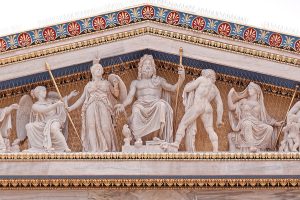
Mythology – Zeus's Adventures in the Big City
The course will review the stories of Greek mythology from the creation of the world to the great wars of Greek mythology.
During the course, we will conduct an introduction to the 12 Olympian gods (among them: Zeus, Hera, Poseidon, Athena, and more), identifying characteristics, and central myths in which they star.
After getting to know the central gods, we will learn about great war stories in mythology (Trojan War, War of the Giants against the Gods – Gigantomachy, and more) and love stories of the gods.
At the same time, we will learn to get to know the writers of the myths (mythographers, among them Homer and Ovid).
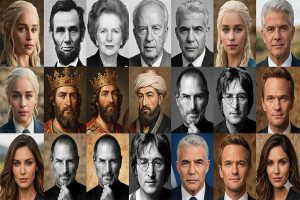
Leadership and Heroes in the Bible, in Media, and Today
Abraham our Father, Moses our Teacher, King David, Abraham Lincoln, Maimonides, David Ben-Gurion, John Lennon, Aviv Geffen, Margaret Thatcher, Steve Jobs, Penina Rosenblum, Khaleesi (“Game of Thrones”), Barney Stinson (“How I Met Your Mother”), and Yair Lapid…
All these will not participate in the course, but we will discuss issues related to these figures and watch films about them, while the following questions will be raised at the focus of the meetings:
- What types of leadership exist and what is similar and different between them?
- Is leadership an innate trait or does there exist a path that trains leaders?
- How do you choose a leader and does he himself choose to be one?
- What is the influence of leaders on the general public?
- Female leadership – does such a thing even exist?
Through a retrospective look at the biblical period, we will observe and try to refine and focus on phenomena related to leadership and leaders, which characterizes humanity from its beginning until today.

Strategic Thinking Games
Strategy games require the players to have a high logical ability, ability to analyze situations, creativity, and the use of a range of techniques for solving problems.
In the course, we will play a variety of thinking games (without any element of luck) such as Abalone and Mancala, as well as games that the students will choose and express special interest in.
We will analyze the winning strategies and the mathematical principles behind them.
We will try to formulate several strategies and investigate the differences between them. We will present critical stages in the various games and discuss questions such as the importance of the opening move and reaching victory in certain situations.
At the end of the course, the students will be able to analyze and present a variety of game strategies.

Law, Communication, and Politics
Introduction to becoming acquainted with the legal and political system in Israel, and its points of intersection with the media and its roles.
In the course, we will try to understand the structure of the governing system in Israel, mainly while focusing on the legal system.
Who are the bodies that compose it, what is the relationship between them, and what is the meaning for the public.
Basic legal concepts will be taught, in addition to an attempt to get to know the law as a significant factor in the citizen’s life.
All this while looking at relevant events from daily life.
Use will be made of a moot court situation; statements of claim and defense will be examined; a bill will be drafted.
In addition, we will examine the activity of the Israeli media, in the legal context and other contexts, while understanding the interests driving it, from the journalist’s point of view.

Debate Team
Israel is a superpower in the field of debate.
In about half of the last world championships for the university debate league, Israeli debaters won.
Some of the winners were debaters who had already participated in the high school debate league in Israel.
What awaits us this year?
The program this year will focus on forming Range Center’s debate team that is destined to compete in Israel’s high school league.
The meetings will combine workshops, games, and activities for acquiring the required skills, debate training, and… participation in league competitions.
Why should you join?
- Debate – a fun sport for smart and creative people (or people who want to be more mentally flexible).
- Development of skills important for the real world – ability of oral expression, critical thinking for others’ arguments, analysis of bills or ideas in a structured way, structured public speaking, developing arguments, and raising confidence in public speaking.
- Learning, through experience in debate, on a variety of topics and from different fields, such as: political science, law, criminology, philosophy, psychology, and more.
So come take part in the team, and be the debaters of tomorrow!
* This is a different course than the course: Rhetoric, Persuasion, and Debate

Topics in Twentieth-Century Physics
At the beginning of the 20th century, a revolution occurred in the world of physics.
Precisely when physicists were sure that all the important questions in the field of physics had been solved and almost nothing remained to be researched, the revolutionary discoveries of Einstein, Bohr, and other physicists brought about an understanding of the essence of radiation and matter and the development of the theory of relativity and quantum theory
In the course, we will discuss the main topics of twentieth-century physics and illustrate abstract ideas using models and computerized simulations.
We will discuss the great discoveries in the field and their importance for technological inventions like computers, television, medical imaging, and more.
In the course, we will deal with the following topics:
- Light and electromagnetic waves, the photoelectric effect, photon, X-rays.
- Structure of matter: atom, periodic table, electricity, models of the atom, de Broglie waves.
- Matter waves, radioactivity: structure of the nucleus, nuclear force, alpha radiation, beta radiation, gamma radiation.
- Nuclear reactions: nuclear binding energy, neutron, nuclear fission, atomic bomb, nuclear reactor, hydrogen bomb.

"Deception": Thinking and Visual Language
The sense of sight is the strongest sense of human beings.
Through the sense of sight, we absorb the world.
The laws of optics and the functioning of the eye do not change, but the world and the interpretation of the objects we see change all the time.
The course will provide students with tools for analyzing the visual messages we absorb.
We all use visual means all the time to convey messages, and we process such messages from the moment we open our eyes until we close them.
The students are invited to discover for themselves daily phenomena related to visual language and the human response to visual stimuli.
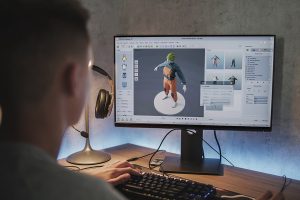
Computer Game Design
- What makes a computer game a good game?
- We were all born game designers, how can we turn our ideas into reality?
The passion to play has accompanied man since the beginning of his path in this world – since the beginning of history, man created for himself various games that allowed him to escape to an imaginary world, to strengthen his skills in a fun way, and simply to pass the time in a more pleasant way.
We were all born game designers; after all, every baby knows how to turn the objects around him into a game.
The digital revolution made games a more complex but more common thing – we all play on the computer or smartphone but have forgotten that it is in our power to create games ourselves.
In this course, we will learn tools that will allow all its participants to become game designers and use their creativity to create new game worlds.
In this course, middle school participants will get a taste of the world of computer game design, will learn its principles, will experiment themselves in research and evaluation of various games, and will create in teams games with the help of Buildbox software – an innovative tool for designing games without code.
In this course, high school participants will get a taste of the world of computer game design, will learn its principles, will experiment themselves in research and evaluation of various games, and will create in teams games with the help of Unity software – the professional and acceptable tool in the industry.

Developing Creativity and Critical Thinking in the Paths of Modern Art
- How can artistic theory be turned into a contemporary work of art?
- What are the ways in which art can be expressed through contemporary technological tools?
In our meetings, we will learn about different periods and works in the history of art.
At the beginning of the school year, we will get to know different and diverse theories, which we will implement through personal creation of painting and sculpture.
We will conduct an introduction to the fundamentals of sculpture and prepare self-portrait sculptures.
Likewise, we will deal with abstract painting in modern and contemporary art, we will get to know artists, and perform personal work.
Later in the year, we will move to the field of video art.
This field is a field in art that uses digital images, usually accompanied by a soundtrack, and makes use of various digital technologies.
We will also deal with performance art. A performance is a show that combines media from various fields: from the field of performing arts, theater, dance, to fields in visual art such as sculpture and cinema.
The lessons will be accompanied by tours in the Hecht Museum at the University of Haifa and the Haifa Museum of Art, in which we will be exposed to works of art from all periods and from all corners of the globe.
We will take our experiences from the exhibitions with us to the lessons in which we will investigate and deepen the findings to which we were exposed in the exhibitions.

Normal and Abnormal Psychology
Human behavior is very complex and differs from person to person.
Psychology, as a research and therapeutic field, attempts to understand and describe behavior, explain it, predict it, and even influence it.
In the course, we will review the basic concepts and main approaches in psychology.
We will be exposed to selected content from various fields in psychology, and during it, students will be introduced to different fields of psychology such as personality theories, learning theories, the development of psychology, social psychology, and psychopathology.
In the course, we will watch films that describe abnormal behaviors and try to analyze together the phenomena according to the material learned during the course.

Spirit of the Times
The course outlines the axis of historical development from the artistic, political, philosophical, ideological, religious, and fashionable aspect in Europe from the ancient period to the present day.
In each lesson, we will analyze a well-known historical figure such as: Cleopatra, Aristotle, Julius Caesar, Jesus, Henry VIII, Elizabeth I, Marie Antoinette, Napoleon, and more.
Through getting to know these figures and the relationships between them, we will learn in each period what they represent and how they reflect the “spirit of the times.”
In order to bring the historical processes to life, various illustrative aids will be used during the course, such as: an image presentation, screening of film clips (such as Cleopatra, Gladiator, Dangerous Liaisons, Marie Antoinette, The Other Boleyn Girl, and Elizabeth), presenting important works of art, and integrating music segments.

Rhetoric, Persuasion, and Debate
- What is the way to fast and effective persuasion?
- How will I acquire confidence to stand in front of an audience?
Rhetoric is the science of speech and persuasion.
Hence, during this course, we will learn a variety of methods for persuasion and speaking in front of an audience, and experiment with them.
First, we will learn about the foundations of rhetoric in ancient times: ethos, pathos, and logos.
Second, we will get to know a variety of means of persuasion, we will learn about the style of conveying the message, and how to build a convincing, short, and to-the-point argument.
Alongside these, we will also get to know demagoguery, its characteristics, and its meaning.
Third, we will learn about structured discussion (the debate), its rules, and its meaning.
For this purpose, we will experiment with a variety of discussions on various topics.
We will spice all this up with touches of rhetoric from the world of media and communication, in videos and films, in riddles and games that are intended to sharpen our ability to convey the message and persuade.
* This is a different course than the course: Debate Team

Psychological Phenomena in the Mirror of Science and Cinema
Who are we? What makes us human? How is our personality determined and developed? Why do we choose to behave in a certain way? What is normality and what is abnormality? And so on and so forth.
In the course, classical psychological theories explaining the complexity of the human mind will be presented.
Likewise, we will deal with psychological phenomena and concepts, while referring to major experiments that were conducted in the field of psychology and to films that demonstrate interesting psychological phenomena.

Visual Communication
- What is the connection between visual communication and fast-food restaurants?
- How is a brand created and can we be a brand ourselves?
We are used to thinking of communication as a verbal thing, but that is only the top layer that is easy for us to interpret.
Most of the information we receive daily is visual – colors, shapes, and compositions shape our actions much more than we tend to think – they determine which videos we watch, which brands we buy, what we choose to buy or eat, and even where it is comfortable for us to be.
The same presentation can fascinate us or not interest us just because of how it looks, or even just because of the color of the shirt of the person who is delivering it.
In this course, we will learn the skills and tools to understand the world around us at a deep level and communicate with it in a better way that communicates our intent more accurately.
Participants will get a taste of the world of visual communication, will learn useful tools that will allow them to express themselves and improve their ability to convey messages on a number of platforms.
Looking for current and updated activities?
Range Center concluded its operations in 2021.
For information on current activities for children and youth at the University of Haifa, we invite you to contact the unit currently in operation.
The Unit for Youth Seeking Environment, Culture, and Science
University of Haifa